How Many Quarts in a Gallon? Quick Conversion & Table
You grab a stockpot, a 1-gallon recipe, and a quart measuring cup. Suddenly you freeze. How often do you fill it? Guessing wrong can destroy a sauce, waste expensive ingredients, and leave you scraping burnt pans. Stop the frustration. One US liquid gallon equals exactly 4 quarts. That simple fact changes everything. You are about to master every quart-to-gallon conversion, the differences nobody explains, and kitchen-cheat shortcuts that save you every time.
What Is a Quart?
In the US customary system, a quart is a unit of liquid volume. Its name comes from the Latin quartus, meaning a fourth part. That origin tells you everything—one quart is a quarter of a gallon. In the United States, a liquid quart equals 32 fluid ounces, 2 pints, or 4 cups. You see it on milk cartons, broth containers, and oil bottles. The dry quart is a separate unit used for fruits, grains, and other dry goods. A dry quart holds about 1.101 liters, slightly more than a liquid quart. Knowing which quart a recipe means prevents measurement disasters.
What Is a Gallon?
A gallon represents a larger volume measurement used mainly in the United States, Liberia, and historically in the UK’s imperial system. The US liquid gallon contains 128 fluid ounces, which is exactly 231 cubic inches. This definition has roots in an old English wine gallon. The imperial gallon, still visible on some Canadian and British packaging, holds 160 imperial fluid ounces and equals about 1.20095 US liquid gallons. If you follow an American recipe that calls for a gallon of milk, you are working with the US gallon of 128 ounces. Using an imperial gallon instead would add nearly 20% more liquid and upset the recipe balance.
How Many Quarts in a Gallon? – The Direct Answer
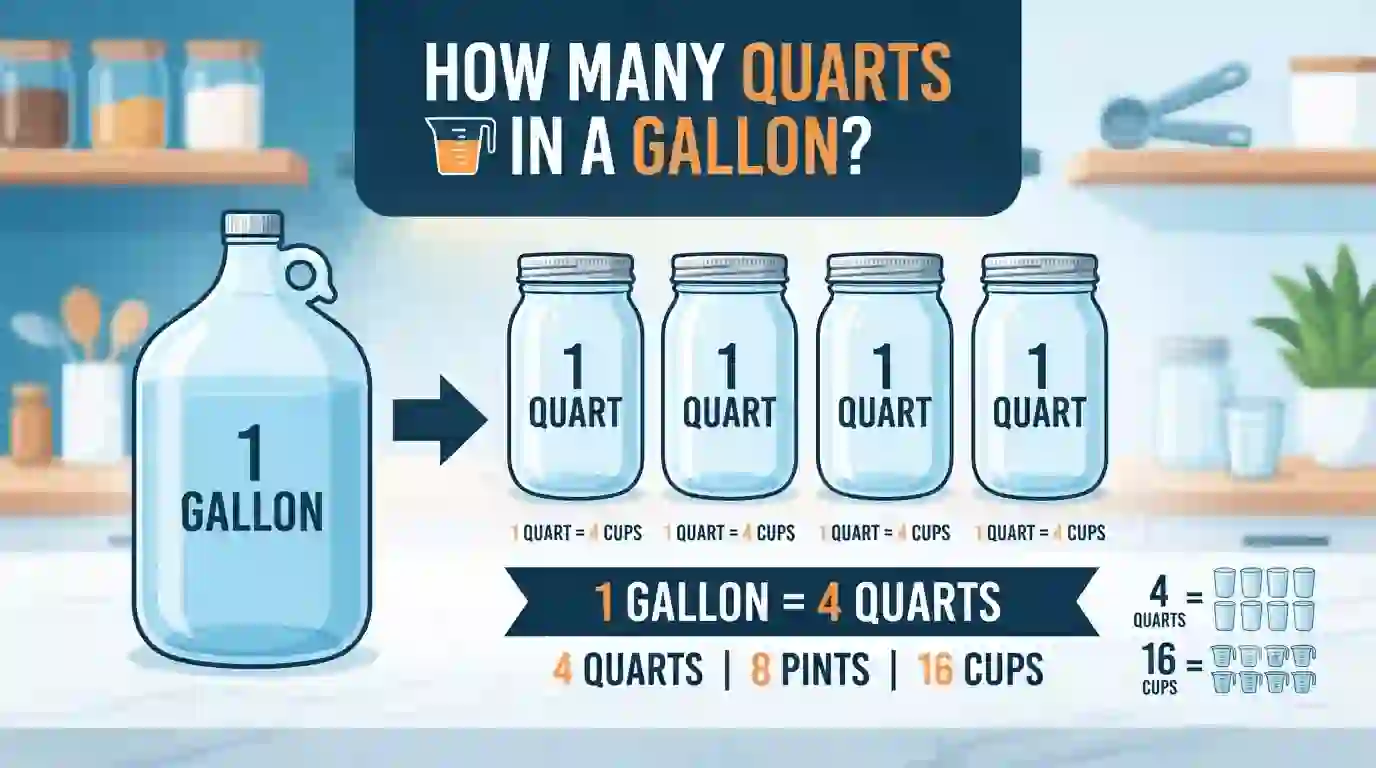
The question “how many quarts in a gallon” receives one definitive answer in the United States: 1 gallon = 4 quarts. This relationship stands firm whether you measure water, paint, or coolant. It works in reverse too. Divide a gallon into four equal parts, and each part is a quart. If a recipe says “half a gallon of stock,” you immediately know that’s 2 quarts. The same logic applies to any liquid in the US customary system. This simple ratio anchors every kitchen, garage, and science lab conversion you will ever make.
The number 4 doesn’t change for liquid gallons and liquid quarts. The moment you step into dry measurements or imperial units, the ratio holds but the actual volume shifts. A dry gallon also contains 4 dry quarts, but each dry quart is larger than a liquid quart. An imperial gallon contains 4 imperial quarts, but the imperial quart is larger than the US liquid quart. The bottom line: when you search “how many quarts in a gallon,” the answer you need for everyday American cooking, fuel, and cleaning is 4.
US Liquid Gallon vs Imperial Gallon
The US liquid gallon and the imperial gallon share the same 4-quart structure but differ in size. A US liquid gallon measures 3.785 liters. An imperial gallon measures 4.546 liters. That nearly 20% difference trips up home cooks who follow vintage British recipes or travelers bringing back Canadian dairy products.
Here is how the two systems compare:
- US gallon: 128 fluid ounces, 3.785 liters, 4 US liquid quarts, 8 US pints, 16 US cups.
- Imperial gallon: 160 imperial fluid ounces, 4.546 liters, 4 imperial quarts, 8 imperial pints, 16 imperial cups.
When you need “how many quarts in a gallon” for a US recipe, use the US gallon’s 4 quarts. For British and Canadian recipes before metric adoption, confirm whether the source expects an imperial gallon. If unsure, look at the cup or pint references. A US pint is 16 fluid ounces, an imperial pint is 20 fluid ounces. That size difference scales up directly to quarts and gallons.
Liquid Quart vs Dry Quart: Know the Difference
A liquid quart sits at 32 fluid ounces (0.946353 liters). A dry quart, used for measuring produce, grains, and berries, equals about 1.101 liters. That’s 1.163 times the volume of a liquid quart. The dry quart belongs to the US dry volume system, which also includes the dry pint and dry gallon. A dry gallon equals 4 dry quarts, so the 1:4 ratio still holds, but the absolute volume is larger than the liquid gallon.
This table explains the gap:
| Unit | Volume (liters) | Fluid ounces equivalent (approx.) |
|---|---|---|
| 1 US liquid quart | 0.946 | 32 fl oz |
| 1 US dry quart | 1.101 | 37.24 fl oz (approx.) |
| 1 US liquid gallon | 3.785 | 128 fl oz |
| 1 US dry gallon | 4.405 | 148.95 fl oz (approx.) |
If you grab a 1-quart measuring cup designed for liquids and try to measure dry berries for a pie, you slightly under-fill compared to the dry quart standard. For most home recipes, the liquid quart works fine. Commercial farming and professional baking demand the dry quart for precision. Remembering this distinction keeps your fruit proportions from collapsing.
Quick Conversion Table: Gallons to Quarts, Pints, Cups, and Ounces
A single reference table wipes out hesitation. Bookmark this or stick it inside a cabinet door.
| Gallons | Quarts | Pints | Cups | Fluid Ounces |
|---|---|---|---|---|
| 0.25 | 1 | 2 | 4 | 32 |
| 0.5 | 2 | 4 | 8 | 64 |
| 0.75 | 3 | 6 | 12 | 96 |
| 1 | 4 | 8 | 16 | 128 |
| 1.5 | 6 | 12 | 24 | 192 |
| 2 | 8 | 16 | 32 | 256 |
| 3 | 12 | 24 | 48 | 384 |
| 4 | 16 | 32 | 64 | 512 |
| 5 | 20 | 40 | 80 | 640 |
This table acts like a visual cheat. When a soup recipe says “add half a gallon of broth,” glance at the 0.5-gallon row. You instantly see 2 quarts, 4 pints, or 8 cups. No math stress. For bigger projects like brining a turkey, the 2-gallon row shows 8 quarts. Everything scales neatly.
How to Convert Gallons to Quarts (and Back)
The formula rests on the foundation you already know. To convert gallons to quarts, multiply the number of gallons by 4. To convert quarts to gallons, divide the number of quarts by 4.
- Gallons × 4 = Quarts
- Quarts ÷ 4 = Gallons
A cook who needs 2.5 gallons of lemonade simply calculates 2.5 × 4 = 10 quarts. A painter who has 14 quarts of primer divides 14 ÷ 4 to get 3.5 gallons. These two steps eliminate every measurement headache. You can insert any decimal or fraction. For half a gallon, 0.5 × 4 = 2 quarts. For 6 quarts, 6 ÷ 4 = 1.5 gallons. The math stays simple, but its reliability saves you from overbuying or coming up short.
If you ever switch between imperial and US gallons, treat them as separate systems. Convert US gallons to US quarts with the 4x rule, then convert to liters if needed. One US gallon equals 3.785 liters. One imperial gallon equals 4.546 liters. Never mix the two without first converting to a shared unit like liters. The National Institute of Standards and Technology (NIST) defines the US liquid gallon as exactly 231 cubic inches, which becomes the baseline for all US volume conversions.
Kitchen Measurement Cheat Sheet for Cooks and Bakers
Professional kitchens treat the gallon as a master unit and break it down. This hierarchy sits inside every successful baker’s head:
- 1 gallon = 4 quarts
- 1 quart = 2 pints
- 1 pint = 2 cups
- 1 cup = 8 fluid ounces
Need 1 cup from a gallon jug? A gallon holds 16 cups. Pour from the gallon into a 1-cup measure 16 times. Need a quart? That’s 4 cups. If your measuring pitcher shows quarts, you’re golden. Many home cooks double recipes that demand 3 gallons of stock for a large gathering. Knowing “how many quarts in a gallon” gives you 12 quarts instantly.
Batch cooking and meal prep depend on these conversions. When you scale a soup from 1 quart to 1 gallon, multiply every ingredient by 4. A spice blend that uses 1 teaspoon per quart becomes 4 teaspoons (1 tablespoon plus 1 teaspoon) per gallon. The same 4x rule governs liquid volumes and proportional seasoning. This approach keeps flavors balanced whether you cook for two or twenty.
Why Precision Matters: Baking, Science, and Automotive Fluids
Baking punishes guesswork. Flour, water, yeast, and salt exist in strict ratios. If a bread formula says “1 quart water per 2 pounds of flour” and you confuse quarts with pints, your dough becomes soup. Professional bakers treat a gallon as 4 quarts and a quart as 32 ounces. Every ounce counts.
Scientific labs use volumetric glassware calibrated to the liter and US gallon. A chemistry protocol might state “add 0.25 gallons of distilled water.” The tech knows that’s 1 quart. Swapping a dry quart for a liquid quart in a reagent mixture alters concentration. Accuracy becomes a safety issue.
Automotive fluids carry the same need for precision. Coolant bottles often list capacities in quarts and gallons. A radiator that takes 2 gallons needs 8 quarts of antifreeze mix. Adding only 6 quarts starves the engine of cooling. Oil change capacities also shift between quarts and gallons. A car requiring 1.5 gallons of oil matches 6 quarts. Reading “how many quarts in a gallon” correctly protects your engine from expensive damage. The U.S. Department of Agriculture (USDA) references volume measures for food production that rely on the same exact conversions, reinforcing how foundational this knowledge is.
Common Conversion Mistakes People Make
Mistakes cluster around three blind spots. First, people treat dry quarts as liquid quarts. A farmer’s market recipe might say “1 quart strawberries.” Without knowing the dry quart, you could undershoot the fruit volume. Second, travelers bring home a British gallon-labeled product and pour 4 US quarts, getting far too much liquid. The imperial gallon adds almost 5 extra cups per gallon. Third, cooks misremember the cup-to-quart ratio, thinking 1 quart equals 3 cups instead of 4. That error shrinks a 1-gallon stockpot by 4 cups.
Another common slip happens with fractions. Someone sees “0.75 gallon” on a cleaner label and pours 3.5 quarts instead of 3 quarts. Using the conversion formula (0.75 × 4 = 3) kills that mistake. Every pour is exact if you learn to halt and employ the 4x rule. Relying on memory alone without a posted conversion chart invites trouble.
Memory Hacks to Always Remember Quart-to-Gallon Ratios
Neural hooks lock in the 4-quart rule. Think of the word quart as “quarter.” A quart is a quarter (1/4) of a gallon. That etymological clue never leaves you. Picture a gallon jug divided into four equal horizontal bands. Each band represents one quart. When you pour to the first band, you have 1 quart. Pour to the second, you have 2 quarts, or half a gallon. This mental image stores the answer forever.
You can also count on your hands. Four fingers equal four quarts in one gallon. Fold one finger for each quart you use. Full hand equals one gallon. Kids learning kitchen skills pick this up instantly. A rhyme helps too: “Four quarts make a gallon, just like four quarters make a whole.” Remembering how many quarts in a gallon becomes as natural as remembering four quarters in a dollar. These tricks transform a fact into reflex.
Frequently Asked Questions
How many quarts in a gallon of milk?
A gallon of milk contains 4 quarts in the United States. Milk sold in gallon jugs splits into 4 equal quarts. Half-gallon cartons equal 2 quarts. Dairy packaging follows the US liquid gallon standard every time.
Does “how many quarts in a gallon” change for dry ingredients?
The ratio remains 4 quarts to 1 gallon, but you use the dry gallon and dry quart system. A dry gallon holds 4 dry quarts, and each dry quart is about 1.101 liters. For most home recipes, the liquid quart measuring cup works acceptably, but precise fruit and grain measures call for dry quart containers.
How many quarts are in an imperial gallon?
An imperial gallon holds 4 imperial quarts. The imperial quart equals 40 imperial fluid ounces, making the gallon 160 imperial fluid ounces. That imperial gallon is roughly 1.2 US liquid gallons. Do not interchange imperial and US quarts in a recipe without converting to liters first.
How do I teach a child how many quarts in a gallon?
Use the four-finger method. Hold up four fingers and explain that each finger stands for one quart. The whole hand represents one gallon. Pour water together into a gallon jug, marking quart lines with tape. Physical action cements the concept far faster than memorization.
What’s the fastest way to convert gallons to quarts in my head?
Multiply the number of gallons by 4. Half a gallon becomes 2 quarts. A quarter gallon becomes 1 quart. For fractional amounts, treat fractions as decimals: 1/4 gallon is 0.25 × 4 = 1 quart. This one-step multiplication works in any kitchen or hardware store aisle.
Why do some recipes list “4 quarts” instead of “1 gallon”?
Recipe writers use quarts when the total volume matches a standard quart container. Listing “4 quarts” signals that you can use four 1-quart cartons or a single gallon jug. It also helps cooks who only own quart measuring cups. The meaning stays identical—it’s always 1 gallon.
Take Control of Every Liquid Measurement
You now own the answer, the table, and the mental tools to never second-guess volume conversions again. When a recipe demands a gallon of stock, you see 4 quarts. When a cooling system calls for 2 gallons, you pour 8 quarts. This knowledge travels from the kitchen to the garage and into every grocery aisle.
Print the conversion table. Tape it inside a cabinet. Teach the four-finger trick to someone else. Each time you apply the 4-quart rule, you deepen a skill that home cooks and professionals rely on daily. Use the exact answer—4 quarts in a gallon—and watch your cooking, baking, and DIY tasks run smoother than ever.