Skink Definition & Meaning: What Is a Skink?
Introduction:
You just spotted a small, fast, smooth-scaled creature darting under a rock in your backyard — and you have no idea if it is a snake, a lizard, or something else entirely. That confusion stops here. The skink meaning is specific, fascinating, and worth knowing — especially if you share outdoor space with these animals. This guide covers everything about skinks clearly: what they are, where they live, how they behave, and what to do if you find one.
Quick Reference: Skink at a Glance
| Feature | Detail |
|---|---|
| Scientific Family | Scincidae |
| Common Name | Skink |
| Type of Animal | Lizard (Reptile) |
| Number of Species | Over 1,500 worldwide |
| Size Range | 3 inches to 14 inches depending on species |
| Habitat | Every continent except Antarctica |
| Diet | Insects, worms, small invertebrates |
| Activity Pattern | Mostly diurnal (active during the day) |
| Notable Feature | Smooth, overlapping scales; some have reduced or no limbs |
| Are They Dangerous? | No — skinks are non-venomous and generally harmless |
| Popular Pet Species | Blue-tongued skink, fire skink, blue-tailed skink |
| Lifespan | 5 to 20 years depending on species and conditions |
What Is the Skink Meaning?
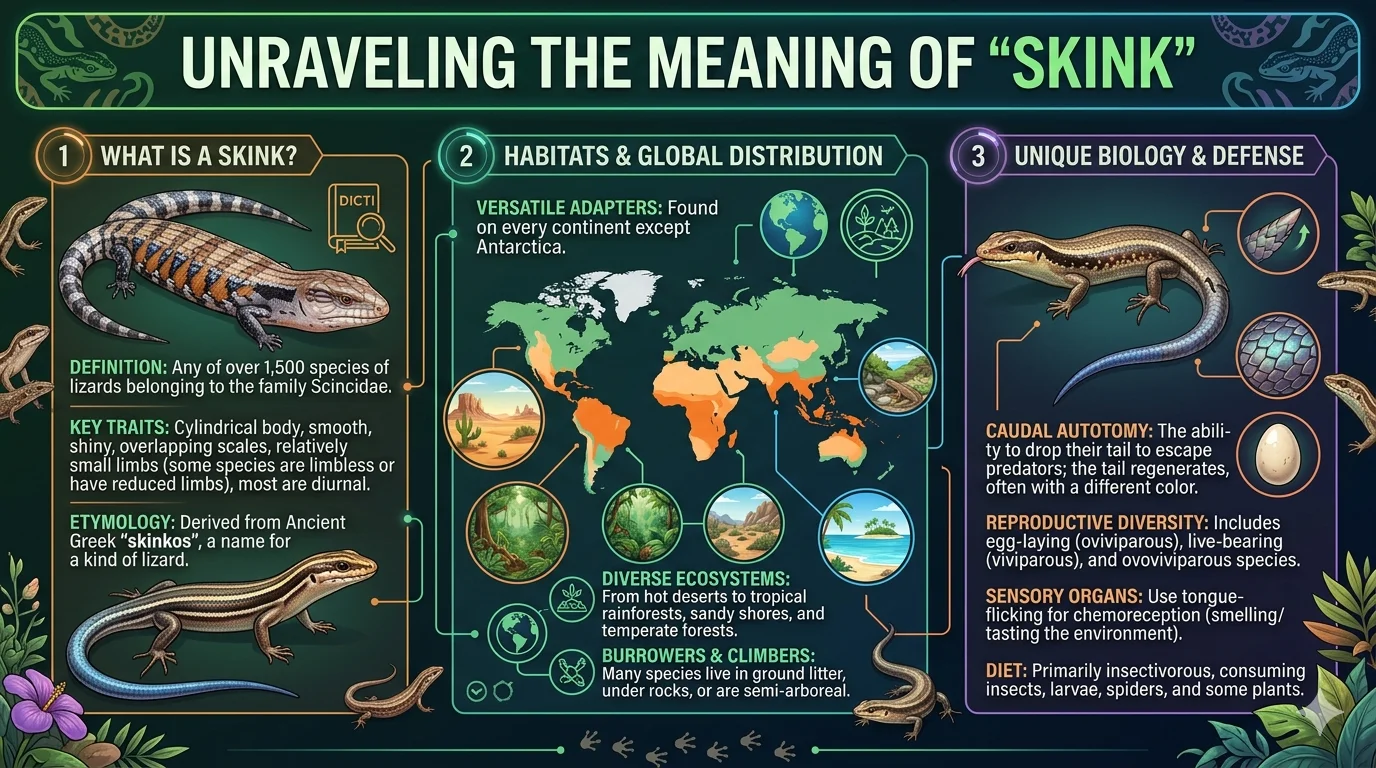
The skink meaning refers to a specific family of lizards known scientifically as Scincidae. Skinks are one of the largest and most diverse families of lizards on Earth, with more than 1,500 recognized species living across six continents.
What separates skinks from most other lizards is their body shape and scale structure. They have smooth, shiny, overlapping scales that give them a sleek, almost metallic appearance. Many species have short or reduced limbs, and a few species have no visible legs at all, which causes people to confuse them with snakes on first sight.
The word skink entered the English language in the 16th century, borrowed from the Latin scincus and the Greek skinkos, both of which referred to a specific type of lizard found in North Africa and the Middle East. Over time, the term expanded to cover the entire Scincidae family as naturalists classified more species around the world.
Full Skink Definition
Skink definition: A skink is any lizard belonging to the family Scincidae, characterized by a streamlined body, smooth overlapping scales, relatively small limbs (or in some species, no visible limbs), and a preference for ground-level or burrowing habitats. Skinks are found on every continent except Antarctica and make up one of the most species-rich lizard families in the world.
The definition covers animals ranging from the tiny, dart-fast garden skinks of Australia to the large, dog-like blue-tongued skinks kept as pets across North America and Europe.
Where Do Skinks Live? Habitat and Distribution
Understanding the skink meaning fully requires knowing where these animals actually live. Skinks are remarkably adaptable. You can find them in:
- Tropical rainforests — dense leaf litter provides cover and food
- Dry deserts and scrublands — many species burrow into sandy soil to escape heat
- Temperate woodlands and gardens — common in North America, Europe, and Australia
- Grasslands and meadows — open ground suits fast-moving, sun-loving species
- Suburban backyards — especially in the southeastern United States and eastern Australia
The five-lined skink (Plestiodon fasciatus) is one of the most commonly spotted species in North American gardens. The blue-tongued skink (Tiliqua scincoides) is a familiar garden visitor across much of Australia. Both species thrive near human activity as long as cover, moisture, and insects remain available.
Skinks generally prefer warm environments, and their activity peaks during daylight hours when temperatures are comfortable for a cold-blooded animal to hunt and move freely.
What Does a Skink Look Like?
When people ask about the skink meaning, appearance is often the first real question. Skinks share a recognizable set of physical traits across most species:
- Body shape: Elongated and streamlined, built for speed or burrowing
- Scales: Smooth and overlapping, often giving a glossy or metallic sheen
- Limbs: Short and functional in most species; reduced or absent in burrowing species
- Tail: Long and often brightly colored — blue, orange, or red tails are common in juveniles
- Eyes: Small but visible, with moveable eyelids (unlike snakes, which cannot blink)
- Tongue: Forked or notched, used to detect scent particles in the air
- Color: Ranges from brown and bronze to vivid blue, orange-striped, and iridescent
One of the most distinctive features of juvenile skinks — particularly the five-lined skink — is a bright blue tail. This coloring serves a direct defensive purpose. When a predator grabs the tail, it detaches and continues to wriggle, distracting the predator while the skink escapes. The tail later regenerates, though the new tail is typically a different color and composed of cartilage rather than bone.
Types of Skinks: Most Common Species
The skink meaning spans an enormous number of species. These are the ones you are most likely to encounter or read about:
Blue-Tongued Skink (Tiliqua scincoides)
The largest and most recognized pet skink species. Named for its bright blue tongue, which it displays as a warning to predators. Grows up to 24 inches and has a calm, docile temperament that makes it ideal for beginner reptile keepers.
Five-Lined Skink (Plestiodon fasciatus)
One of the most common skinks in North America. Adults are brown with five faded lines running along the body. Juveniles have a vivid blue tail. Frequently spotted in gardens, woodpiles, and rocky areas across the eastern United States.
Blue-Tailed Skink (Plestiodon laticeps / Cryptoblepharus spp.)
The term “blue-tailed skink” is used for several species across different regions. The bright blue tail in juveniles is a widely recognized trait. Adults lose much of the blue coloring as they mature.
Fire Skink (Mochlus fernandi)
A striking West African species with bold red, orange, black, and white patterning. Popular in the pet trade for its vivid appearance. More secretive and burrowing than blue-tongued skinks.
Sandfish Skink (Scincus scincus)
A desert species native to North Africa and the Middle East — one of the original animals referred to by the ancient Greek term skinkos. Famous for its ability to “swim” through loose sand using a wave-like body motion.
Schneider’s Skink (Eumeces schneiderii)
Another species native to the Middle East and Central Asia. Medium-sized, docile, and increasingly popular in the pet trade. Sometimes called the “Berber skink.”
Skink vs. Lizard: What Is the Difference?
A common question connected to the skink meaning is whether skinks and lizards are the same thing. Here is the precise answer:
Not all lizards are skinks, but all skinks are lizards.
Skinks belong to the order Squamata and the suborder Lacertilia — the same classification as geckos, iguanas, monitor lizards, and chameleons. What makes skinks distinct within that broader group is their family classification (Scincidae) and their specific physical traits.
| Feature | Skinks | Other Lizards |
|---|---|---|
| Scale texture | Smooth and overlapping | Varies widely — rough, keeled, granular |
| Limb development | Often short or reduced | Typically well-developed |
| Body shape | Elongated, streamlined | Varies from stocky to slender |
| Movement | Fast ground movement or burrowing | Climbing, jumping, or walking |
| Ear opening | Visible in most species | Varies by species |
| Tongue shape | Forked or slightly notched | Varies — thick or forked |
| Habitat preference | Mostly ground-level or underground | Varies — trees, rocks, ground |
The easiest way to identify a skink compared to a random lizard is to look at the scales. That smooth, shiny, almost snakeskin-like texture is the defining visual feature of the Scincidae family.
What Do Skinks Eat?
Diet is central to understanding the skink meaning in a biological sense. Skinks are primarily insectivores, meaning insects make up the bulk of their diet. Depending on the species and size, a skink’s menu includes:
- Crickets, beetles, and grasshoppers
- Earthworms and grubs
- Caterpillars and moth larvae
- Spiders and small arachnids
- Slugs and snails
- Small lizards (in larger species)
- Fruit and plant matter (in omnivorous species like blue-tongued skinks)
Blue-tongued skinks stand out because they are genuinely omnivorous. In the wild, they eat berries, flowers, plant shoots, snails, and insects — making their captive diet one of the most varied among commonly kept pet reptiles.
Most small garden skinks hunt actively during warm daylight hours. They use their forked tongue to detect scent trails left by insects, then use speed and agility to capture prey.
Are Skinks Dangerous to Humans or Pets?
This question comes up often when people discover the skink meaning for the first time, usually after finding one in their yard. The clear answer: skinks are not dangerous to humans.
Skinks are non-venomous. They carry no poison. They do not attack people unprovoked. A skink that feels cornered may bite, but the bite of even the largest species — such as the blue-tongued skink — causes minor discomfort at most and poses no medical risk to healthy adults.
For household pets, the situation requires a little more nuance:
- Dogs and cats may chase or kill skinks, but skinks pose no direct danger to these animals
- In some regions, brightly colored skinks have been mistaken for poisonous animals — this is a myth with no scientific basis
- Salmonella is a real concern with any reptile, including skinks. Always wash hands thoroughly after handling any skink or touching surfaces where they have been
Skinks are actually beneficial to have in a garden. They eat large numbers of insects, including garden pests like beetles, caterpillars, and grubs, which makes them natural pest controllers.
Skink Meaning in Language: Etymology and Word History
The word skink has a specific and traceable word history that most people never explore. Its journey through languages reflects the history of natural science itself.
- Ancient Greek: skinkos — referred to a specific lizard in North Africa, possibly the sandfish skink
- Latin: scincus — used in Roman natural history writing, including by Pliny the Elder in his encyclopedia Naturalis Historia (77 AD)
- Medieval European medicine: Ground skink was used as an ingredient in some medicinal preparations — a practice recorded in early pharmacopeias
- 16th-century English: The word skink entered English, initially referring to the specific North African animal
- Modern English: The term now applies to the entire family Scincidae, covering more than 1,500 species worldwide
Interestingly, the word skink also exists as an unrelated Scottish and Irish word meaning “a thin soup or broth.” That culinary term shares spelling but has entirely different Norse and Germanic roots — a genuine linguistic coincidence.
Skinks as Pets: What You Need to Know
The skink meaning in a pet care context is increasingly relevant. Blue-tongued skinks in particular have become one of the most popular pet lizards in the world, and for good reason.
Why people choose skinks as pets:
- Docile temperament, especially blue-tongued skinks
- Manageable size — most pet species stay under 24 inches
- Diurnal activity (active during the day, so you actually see them)
- Adaptable diet that is easy to source
- No venom, no aggression when properly handled
Basic care requirements for a blue-tongued skink:
| Requirement | Recommendation |
|---|---|
| Enclosure size | Minimum 4 feet × 2 feet for an adult |
| Temperature (basking spot) | 100–110°F (38–43°C) |
| Temperature (cool side) | 75–80°F (24–27°C) |
| Humidity | 40–60% |
| Diet | Insects, leafy greens, fruit, occasional protein |
| Lifespan in captivity | 15–20 years with proper care |
| Lighting | UVB lighting recommended |
Fire skinks and Schneider’s skinks are also popular among intermediate keepers who want a species with more color and slightly more specialized care needs.
Frequently Asked Questions
1. What is the skink meaning in simple terms?
A skink is a type of lizard belonging to the family Scincidae. Skinks have smooth, shiny scales, streamlined bodies, and often small or reduced limbs. They live on every continent except Antarctica and are completely harmless to humans.
2. Is a skink a lizard or a snake?
A skink is a lizard, not a snake. Some species have reduced limbs that make them look snake-like, but skinks have visible ear openings, moveable eyelids, and a different skull structure that clearly distinguish them from snakes. If you see eyelids, it is a lizard.
3. Are skinks poisonous or venomous?
No — skinks are neither poisonous nor venomous. No skink species produces or delivers venom. The myth that blue-tailed skinks are toxic to cats has circulated online but lacks any scientific support. Skinks are safe animals and cause no medical harm through biting or skin contact.
4. Why do skinks have blue tails?
Juvenile skinks use their bright blue tails as a distraction for predators. When a predator grabs the tail, it breaks off and continues moving, allowing the skink to escape. This process is called caudal autotomy. The tail regrows over time, though the replacement is typically cartilage and a darker color.
5. What does a skink eat?
Most skinks eat insects, worms, and small invertebrates. Larger omnivorous species like the blue-tongued skink also eat fruit, leafy vegetables, snails, and occasional protein sources. In gardens, skinks provide natural pest control by consuming beetles, caterpillars, and grubs.
6. Can you keep a skink as a pet?
Yes — many skink species make excellent pets. The blue-tongued skink is the most popular choice due to its calm nature, manageable size, and varied diet. They require a proper enclosure with temperature gradients, UVB lighting, and a balanced diet to thrive in captivity. Lifespan in captivity can reach 15 to 20 years with good care.
The Skink: A Remarkable Animal Worth Knowing
The skink meaning covers far more than a simple dictionary entry. From the ancient Greek word skinkos to the 1,500-plus species that inhabit every warm corner of the planet, skinks represent one of the most successful reptile families in evolutionary history.
They live in deserts, rainforests, suburban gardens, and living room terrariums. They control insect populations, escape predators by shedding their tails, and — in the case of blue-tongued skinks — make genuinely rewarding pets. The next time you spot a fast, smooth-scaled animal in your garden, you will know exactly what you are looking at.
If you found a skink in your yard and want to know more about your local species, search your regional wildlife authority’s database or contact a local herpetological society. They can identify your specific species and give you region-appropriate guidance on living alongside these valuable animals.