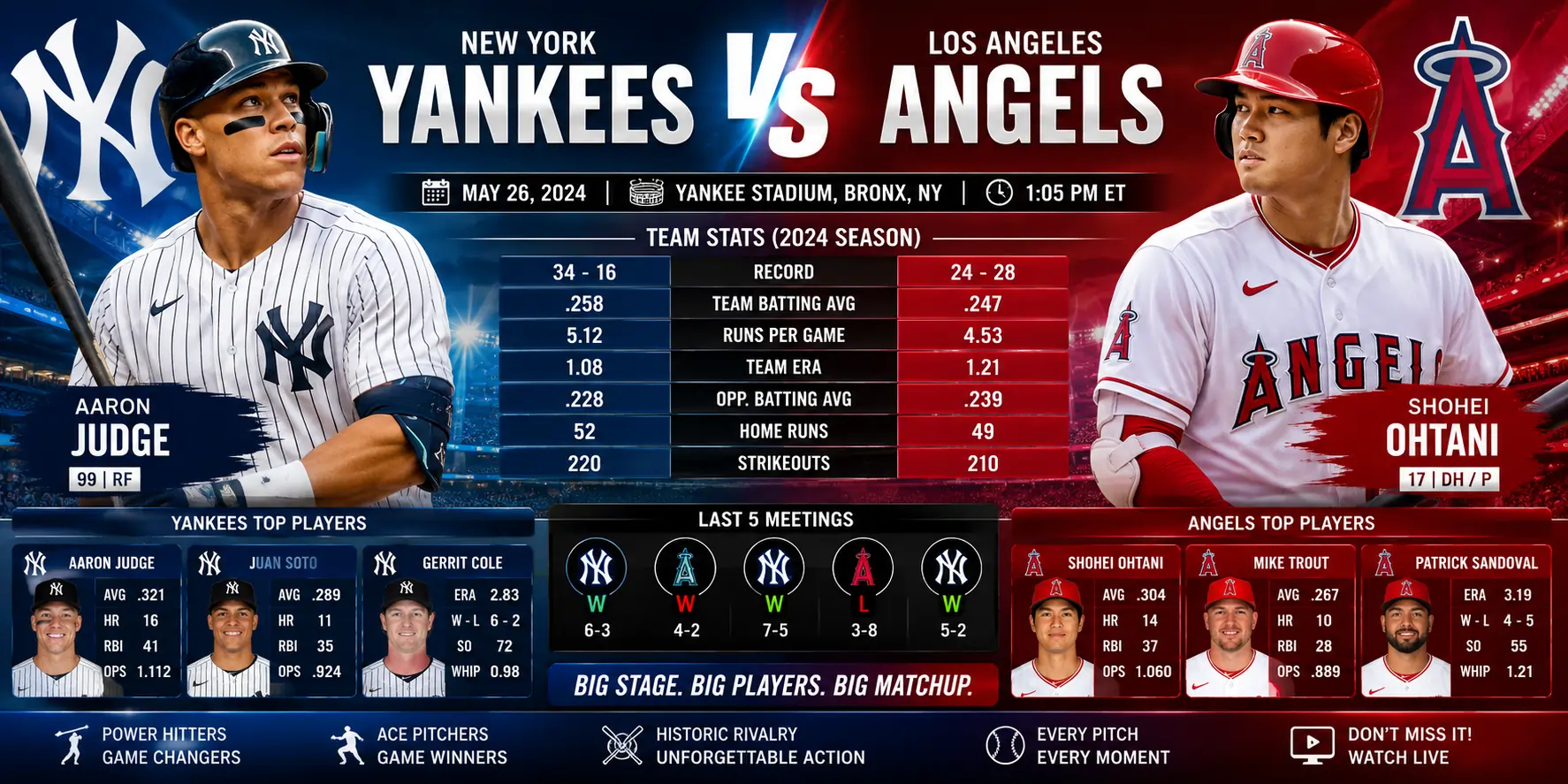
New york yankees vs angels match player stats, Series Breakdown & What It All Means
The four-game set between the yankees vs angels at Yankee Stadium this past April had everything — late-inning chaos, historic individual performances, and a split that perfectly captured where both franchises stand right now.You already know it was a must-see baseball game if you were watching. If you missed it, here’s everything that happened, stat by stat, moment by moment.
How the Series Unfolded
Neither team dominated start to finish. The Yankees and Angels each won two games, but the way those games played out told two very different stories.
The Yankees squeezed out their victories in dramatic, heart-pounding fashion — both wins came down to the final inning. The Angels took theirs convincingly, outscoring New York by a combined 18-5 in Games 2 and 4. That contrast matters when you’re trying to understand what this series actually revealed about both rosters.
Game-by-Game Results
Game 1 — Yankees 11, Angels 10 A nine-inning rollercoaster that saw the Yankees erase a two-run deficit in the bottom of the ninth. Trent Grisham delivered a clutch two-run homer to tie the game, and José Caballero eventually scored the winning run on a wild pitch. Mike Trout hit two home runs and drove in five — and his team still lost.
Game 2 — Angels 7, Yankees 1 Los Angeles came out swinging, literally. Three consecutive home runs in the first inning silenced the Yankee Stadium crowd early, and the Angels’ pitching kept New York’s lineup quiet all night.
Game 3 — Yankees 5, Angels 4 Another walk-off for New York. A miscommunication between Angels infielders on a shallow pop-up opened the door, and Caballero walked through it with a two-run double that scored Jazz Chisholm Jr. and Austin Wells.
Game 4 — Angels 11, Yankees 4 The Angels closed strong. Trout added his fifth home run of the series, and Jo Adell capped things with a grand slam that put the result out of reach early.
| Team | G1 | G2 | G3 | G4 | Total Runs | Total Hits |
| Los Angeles Angels | 10 | 7 | 4 | 11 | 32 | 35 |
| New York Yankees | 11 | 1 | 5 | 4 | 21 | 30 |
Yankees Batting: Who Showed Up
The Yankees didn’t have one dominant offensive voice — they had several, and that depth is a big reason why they’re sitting near the top of the American League.
Trent Grisham was the pleasant surprise. Batting .400 for the series with two home runs and eight RBIs, he delivered when it mattered most: the tying shot in the ninth inning of Game 1 stands as one of the highlights of their entire April.
Aaron Judge continued doing Aaron Judge things. Three home runs, six RBIs, a .286 average — including a 382-foot solo shot in Game 2 that served as a reminder that even in a loss, he’s a constant threat.
Giancarlo Stanton contributed two home runs and held his own at .250. José Caballero only hit one homer but drove in five runs and scored three, repeatedly coming through in high-leverage moments that don’t always show up cleanly in a box score.
| Player | G | HR | RBI | R | AVG |
| Aaron Judge | 4 | 3 | 6 | 4 | .286 |
| Trent Grisham | 4 | 2 | 8 | 4 | .400 |
| Giancarlo Stanton | 4 | 2 | 4 | 3 | .250 |
| José Caballero | 4 | 1 | 5 | 3 | .259 |
| Jazz Chisholm Jr. | 4 | 0 | 3 | 4 | .201 |
Source: Baseball-Reference.com — April 2026 series
Ben Rice deserves a mention even though he’s not in that table. His 13th homer of the season came in Game 4, and his 1.113 OPS through the first month of the year suggests he could be one of the league’s best-kept secrets.
Mike Trout Put on a Clinic
Let’s be honest about what happened here: Mike Trout had one of the great individual series performances in recent Yankees-Angels history, and his team still only went 2-2.
Five home runs across four games. Nine RBIs. A .375 average. He became just the fourth player ever to hit five homers in a single series against the Yankees — and he did it at Yankee Stadium, where the crowd doesn’t exactly roll out a welcome mat for visiting sluggers.
In Game 1 alone, he launched two home runs and drove in five runs. His two-run blast in Game 2 was part of the first-inning explosion that changed the tone of the whole series. In Game 4, his fifth homer essentially served as an exclamation point.
None of that was enough, because the Angels don’t have nearly enough around him.
| Player | G | HR | RBI | R | AVG |
| Mike Trout | 4 | 5 | 9 | 6 | .375 |
| Logan O’Hoppe | 4 | 1 | 3 | 2 | .205 |
| Adam Frazier | 4 | 1 | 2 | 2 | .246 |
| Zach Neto | 4 | 0 | 2 | 3 | .216 |
| Nolan Schanuel | 4 | 0 | 3 | 1 | .257 |
Source: Baseball-Reference.com — April 2026 series
Logan O’Hoppe hit his first career home run at Yankee Stadium, a meaningful moment for a young catcher from Long Island. Jo Adell’s grand slam in the finale showed flashes of the upside the Angels have been waiting for him to deliver consistently.
Pitching: Where the Series Was Won and Lost
On the mound, neither team was dominant — but the Angels had the edge overall.
Angels pitching highlights: Kyle Hendricks was outstanding in the opener, striking out nine over seven innings while allowing just four hits. Sam Aldegheri earned the win in Game 4 with a strong outing against a Yankees lineup that had been rolling. The one black mark for Los Angeles: closer Jordan Romano blew two saves, both in walk-off losses. Those two blown saves are the difference between a series win and a split.
Yankees pitching highlights: Will Warren matched his career best with 11 strikeouts across six innings of work — a performance that kept New York competitive when their bats went quiet. Luis Gil gave up three home runs but managed to keep the Yankees within striking range in Game 3. Max Fried struggled in the finale, allowing four runs and taking the loss.
| Team | ERA | WHIP | K | BB |
| New York Yankees | 5.12 | 1.35 | 38 | 14 |
| Los Angeles Angels | 4.21 | 1.28 | 36 | 16 |
Source: ESPN and Fox Sports box scores
The Angels’ better ERA and WHIP reflect the dominant performances in Games 2 and 4. But Romano’s collapses in close games handed New York two wins it might not have otherwise earned.
Three Moments That Defined the Series
Some plays just live longer than the final score. These three will be replayed in Yankees-Angels highlight packages for years.
Grisham’s ninth-inning homer (Game 1): Down 10-8 with two outs, the Yankees needed something big. Grisham delivered a two-run shot that tied the game and flipped the momentum entirely. Without it, the Angels take the series 3-1.
The Angels’ pop-up miscommunication (Game 3): With the game tied in the ninth, shortstop Zach Neto and third baseman Oswald Peraza both went for a shallow pop-up and neither caught it. The ball dropped. What followed was Austin Wells drawing a walk, and then Caballero lining a two-run double into the gap. An infield error that decided a game.
Trout’s eighth-inning blast (Game 1): Even in a loss, this was remarkable. Trout gave the Angels what seemed like an insurmountable 10-8 lead with two innings to go. That it wasn’t enough doesn’t diminish how good the at-bat was.
Where Both Teams Stand in 2026
This series didn’t happen in a vacuum. Context matters.
New York Yankees (26-16) The Yankees are one of the best teams in baseball right now. They rank in the top five in runs scored, third in team ERA, and carry a 98.8% playoff probability through 43 games. Aaron Judge is on pace for another historic power season with 16 home runs already. And Gerrit Cole, who hasn’t thrown a pitch in the majors yet this year, recently hit 99.6 mph during a minor league rehab start. When he comes back, this rotation gets significantly better.
Los Angeles Angels (16-26) The Angels are in a difficult spot. They rank 27th in team batting average and 21st in ERA. Their playoff odds sit at 0.1%. Mike Trout — posting a .419 on-base percentage and a .936 OPS — is doing everything physically possible to keep them afloat. But one elite player, no matter how generational, can’t overcome roster-wide inconsistency over 162 games.
All-Time Head-to-Head Context
The Yankees and Angels have played a lot of baseball over the decades, and New York has the clear historical edge — leading the all-time series 381-311. Over the past three seasons (2023–2025), the Yankees hold an 8-7 advantage, which shows how competitive recent matchups have been despite the talent gap.
The Yankees’ longest winning streak against the Angels is seven games. The Angels’ longest streak against New York is three. Yankee Stadium hasn’t been kind to Los Angeles, though this series proved they can absolutely win there when their pitching and Trout align.
Frequently Asked Questions
Who hit the most home runs in the April 2026 Yankees-Angels series?
Mike Trout led everyone with five home runs across four games — one of the most impressive individual power displays against the Yankees in recent memory.
Who drove in the most runs?
Trout again, with nine RBIs. Trent Grisham led the Yankees with eight.
What was the final series result?
A 2-2 split. The Yankees won Games 1 and 3 in walk-off fashion; the Angels took Games 2 and 4 decisively.
How did Aaron Judge perform?
Three home runs, six RBIs, a .286 average — solid production, including a 382-foot homer in Game 2.
Where can I find official stats from this series?
MLB.com, Baseball-Reference.com, and ESPN all carry full box scores and individual player logs for every game.
Final Thoughts
The April 2026 Yankees-Angels series was a genuinely entertaining four-game stretch that gave fans exactly what they want: big hits, late-inning drama, and a superstar performance worth talking about long after the final out.
Mike Trout was otherworldly. The Yankees were clutch when they had to be. The Angels showed that Romano in high-leverage spots remains a concern, and the Yankees showed that their lineup can produce damage from anywhere in the order.
As the season continues, New York looks like a World Series contender. Los Angeles looks like a team hoping Trout stays healthy enough to make things interesting until the trade deadline.
That gap in trajectory is the real story of this series — even if the final record said 2-2.