Water Heater Repair: The Complete Guide to Signs, Costs, and Fixes
Reviewed by Marcus Delgado, Licensed Master Plumber (18 years in residential plumbing) | Last updated: August 2026
Cold water blasting through your shower is more than annoying. Left alone, a failing unit can flood your floor, spike your energy bill, or leave your family without hot water for days. The good news? Most water heater repair issues come with clear warning signs and affordable fixes. This guide breaks down exactly what to check, what it costs, and when to call a professional.
What Is Water Heater Repair? Definition & Meaning
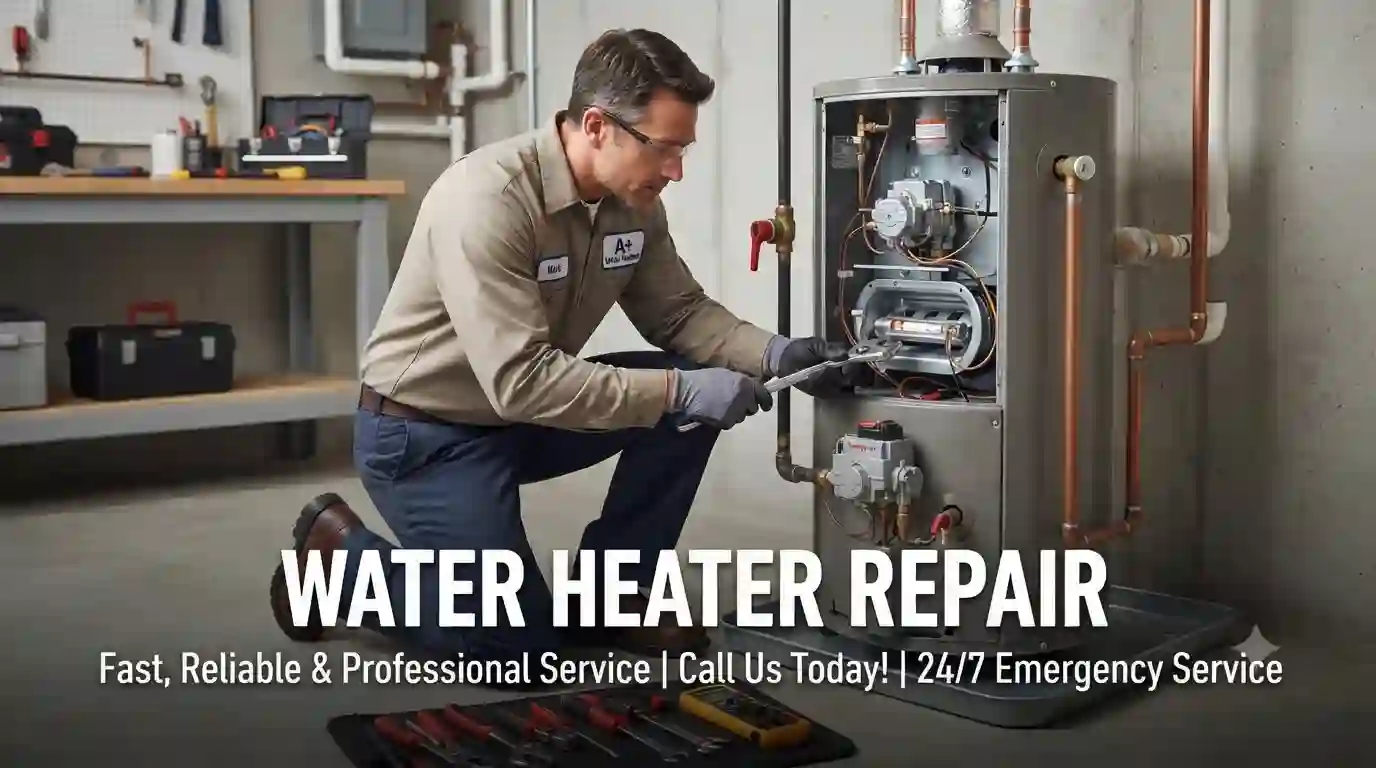
Water heater repair means diagnosing why a water heater has stopped working correctly and fixing the specific part responsible. It covers everything from swapping a worn heating element to sealing a leaking valve or restoring gas flow to the burner.
The goal here is simple: bring back safe, steady hot water without paying for a brand-new unit. A skilled technician isolates the failed component, tests it, and replaces or repairs only what’s broken.
Here’s a quick reference table so you understand the exact terms used throughout this guide.
| Term | Definition & Meaning |
|---|---|
| Water Heater Repair | Fixing one failed part (thermostat, element, valve) to restore normal operation |
| Water Heater Replacement | Installing an entirely new unit when repair is unsafe, unavailable, or not worth the cost |
| Anode Rod | A sacrificial metal rod that attracts corrosion and protects the tank; needs swapping every 3–5 years |
| TPR Valve | Temperature and Pressure Relief valve; releases excess pressure so the tank doesn’t rupture |
| Sediment Flush | Draining the tank to remove mineral buildup that causes noise and cuts efficiency |
| Tankless Descaling | Circulating a cleaning solution through a tankless unit to dissolve mineral scale |
| Heating Element | The electric component that heats water inside an electric tank unit |
| Thermocouple | A safety sensor on gas units that shuts off gas flow if the pilot light goes out |
How Do You Know You Need Water Heater Repair?
Short answer: Watch for cold or lukewarm water, strange noises, rusty water, puddles near the tank, or a rotten-egg smell — these are the clearest signs your unit needs attention.
Here are the eight signs that almost always point to a repair, not a coincidence:
- No hot water, or water that turns lukewarm within minutes
- Rust-colored or cloudy water coming from the hot tap
- Popping, rumbling, or banging sounds from the tank
- Water collecting around the unit is base
- A rotten-egg smell near the tank or faucets
- A gas pilot light that won’t stay lit
- Reduced hot water pressure or flow
- A sudden, unexplained jump in your energy bill
Do not wait if you see even one of these indicators. Small issues, like a failing thermostat, are cheap to fix today and expensive to ignore for six months.
Common Issues with Water Heaters and Their Causes
Every repair starts with finding the right cause. Guessing wastes time and money, so use this table to match your symptom to the likely culprit.
| Problem | Likely Cause | Typical Fix |
|---|---|---|
| No hot water | Failed heating element or extinguished pilot light | Replace element or relight pilot |
| Lukewarm water only | Faulty thermostat or an undersized tank for your household | Recalibrate or replace the thermostat |
| Rusty water | Corroded anode rod or failing tank lining | Replace the anode rod, or the tank itself |
| Water pooling under the tank | Cracked tank, loose fitting, or a failed valve | Tighten fittings, replace the TPR valve, or replace the unit |
| Loud popping or rumbling | Sediment buildup at the bottom of the tank | Flush and drain the tank |
| Rotten-egg smell | Bacteria reacting with the anode rod | Flush the tank and swap the anode rod |
| Pilot won’t stay lit | Faulty thermocouple | Replace the thermocouple |
| Leak near the top of the unit | Loose inlet or outlet connections | Tighten or reseal the fittings |
Safe DIY Water Heater Troubleshooting Steps
A few checks are safe to try before calling a technician. Others are not — and attempting them yourself can be dangerous. Follow these steps first:
- Check the power source. For electric units, confirm the breaker hasn’t tripped. For gas units, confirm the gas supply valve is open.
- Inspect the thermostat setting. It should sit at 120°F. A setting that’s too low mimics a broken unit.
- Look at the pilot light. If it’s out on a gas model, follow the relighting instructions printed on the tank.
- Listen for sediment. Rumbling sounds usually mean it’s time for a flush, a task most homeowners can handle with a garden hose.
- Check for visible leaks. Trace any water back to its source — a loose fitting is often an easy fix.
- Test the TPR valve. Lift the lever briefly; it should release a burst of water. If nothing happens, the valve likely needs replacement.
Stop here if you smell gas, see exposed wiring, or notice water pooling under a cracked tank. These situations call for a licensed professional, not a weekend project.
When Should You Call a Professional for Water Heater Repair?
Short answer: Call a licensed plumber immediately if you smell gas, see sparking or exposed wires, notice the tank itself is leaking, or you’re not confident working around gas lines and electrical components.
A professional brings the right tools, safety training, and code knowledge to the job. Gas system work, in particular, carries real risk — a poorly reconnected gas line can cause a leak or fire. Electrical repairs on tank units carry a shock risk if the power isn’t fully isolated first.
Beyond safety, a technician can also spot problems you might miss, like a corroded fitting that’s about to fail or a warranty that still covers the part. Many manufacturers void warranties if an unlicensed person opens certain components, so hiring a licensed professional often protects your investment too.
How Much Does Water Heater Repair Cost?
Short answer: Most homeowners pay between $150 and $700 for a standard repair, with a national average landing around $300 to $600 depending on the part, labor rate, and unit type.
According to Angi’s 2026 cost data, professional repairs typically range from roughly $90 on the low end to $1,800 for the most involved jobs, with the average homeowner spending around $600 (Angi, 2026). Here’s how individual repairs typically break down:
| Repair Type | Average Cost Range |
|---|---|
| Thermostat replacement | $100 – $350 |
| Heating element replacement | $100 – $350 |
| Anode rod replacement | $150 – $250 |
| Gas control valve replacement | $300 – $500 |
| Pressure relief (TPR) valve | $150 – $200 |
| Tank flush / sediment removal | $80 – $200 |
| Tankless unit repair | $300 – $700 |
| Full-tank replacement (for comparison) | $880 – $1,800 |
Labor rates, part availability, and how easily a technician can access your unit all affect the final invoice. A water heater tucked in a tight attic crawlspace almost always costs more to service than one sitting in an open garage.
Water Heater Repair vs. Replacement: How Do You Decide?
Short answer: If the repair costs more than half the price of a new unit, or your water heater is past 8–10 years old, replacement usually makes more financial sense than another round of repairs.
Weigh these three factors before deciding:
- Age of the unit. Standard tank water heaters last about 8 to 12 years; tankless units can run 15 to 20 years with proper care.
- Repair cost versus replacement cost. A $150 thermostat swap on a 3-year-old unit is an easy call. An $800 repair on a 12-year-old tank is not.
- Frequency of breakdowns. A unit that needs a new part every few months is signaling it’s near the end of its service life, even if each individual fix seems affordable.
A trustworthy technician will walk you through this math honestly instead of pushing an unnecessary replacement.
How to Find Reliable Water Heater Repair Near Me
Searching “water heater repair near me” pulls up dozens of options fast, but speed isn’t the same as quality. Use this checklist to vet anyone before they touch your plumbing or gas lines:
- Confirm they hold a current state plumbing license
- Ask for proof of liability insurance
- Check recent reviews for mentions of punctuality and clear pricing
- Request a written estimate before any work begins
- Ask whether the visit includes a warranty on parts and labor
- Avoid companies that quote a price over the phone without seeing the unit
Local trade associations, including the Plumbing-Heating-Cooling Contractors Association (PHCC), maintain directories of licensed members and can be a solid starting point if you’re unsure who to call (PHCC, 2026). A same-day water heater repair near me search is convenient, but a five-minute background check saves you from a rushed or overpriced job.
Tank vs. Tankless Water Heaters: How Repair Differs
Tank and tankless units fail in different ways, and repair costs reflect that difference.
Tank water heaters typically develop issues with the thermostat, heating element, anode rod, or sediment buildup. Most tank repairs are straightforward, affordable, and completed within a single visit.
Tankless water heaters rely on sensors, igniters, and heat exchangers, so repairing one often costs more per visit — commonly $300 to $700. On the upside, tankless units generally last longer and need less frequent servicing when descaled on schedule.
Both types benefit from routine maintenance, but tankless units are especially sensitive to hard water, which speeds up mineral scale buildup inside the heat exchanger.
Water Heater Maintenance Tips That Prevent Future Repairs
The least expensive insurance against a costly breakdown is routine care. Add these habits to your yearly home maintenance list:
- Flush the tank once a year to clear sediment (twice a year in hard-water areas)
- Test the TPR valve annually to confirm it releases pressure properly
- Inspect the anode rod every 2 to 3 years and replace it once it’s thin or heavily coated
- Keep the thermostat at 120°F, the setting recommended by the U.S. Department of Energy for safety and efficiency (Department of Energy, 2026)
- Insulate exposed hot water pipes to reduce strain on the unit
- Keep at least two feet of clear space around the tank for airflow and safe servicing
Homeowners who follow this routine typically stretch a unit’s lifespan by several extra years and avoid most emergency calls entirely.
Water Heater Safety Precautions During Repair
Follow these precautions before any repair work begins, whether you’re doing it yourself or a technician is on-site:
- Shut off the power at the breaker or the gas supply valve before inspecting anything
- Never bypass or disable the TPR valve — it exists to prevent tank rupture
- Ventilate the area if you smell gas, then leave and call your utility company immediately
- Keep the thermostat at or below 120°F; the Consumer Product Safety Commission notes that water above this temperature significantly raises the risk of scald injuries, especially for children and older adults (CPSC, 2026)
- Let the tank cool before draining it to avoid burns from hot water or steam
Safety isn’t optional here. A water heater combines pressurized water, electricity or gas, and heat — all three demand respect.
Choosing the Right Water Heater Replacement Near Me
When repair no longer makes sense, searching for a water heater replacement near me is the next step. Keep these factors in mind while comparing quotes:
- Sizing. A unit too small for your household runs out of hot water fast; oversized units waste energy.
- Fuel type. Match the replacement to your existing gas or electric setup unless you’re planning a larger renovation.
- Efficiency rating. Look for an Energy Star-certified model to lower long-term utility costs.
- Warranty length. Longer warranties (8–10 years) often signal a higher-quality tank.
- Permits. Reputable installers pull the required permits; skipping this step can create issues when you sell your home.
Well-known manufacturers such as Rheem, A.O. Smith, Bradford White, Rinnai, and Navien all produce reliable residential units, though the best choice depends on your household size, fuel type, and budget.
How Long Does Water Heater Repair Take?
In a nutshell: After a technician comes, most repairs take one to three hours. Full replacements typically take three to five hours, including removal of the old unit.
Simple fixes, like replacing a thermostat or flushing sediment, are usually finished in under an hour. More involved jobs, such as a gas control valve swap or diagnosing an intermittent leak, can stretch closer to three hours. Emergency same-day service is common for no-hot-water calls, so you’re rarely without service for more than a day.
Frequently Asked Questions
1. What is water heater repair? Water heater repair is the process of diagnosing and fixing a specific failed part — such as a thermostat, heating element, or valve — to restore hot water without replacing the entire unit. A technician tests each component individually to isolate the exact cause before recommending a fix.
2. How much does water heater repair cost on average? Most homeowners spend $300 to $600 on a standard repair, though simple fixes can run as low as $90 and complex jobs can reach $1,800. The final price depends on the part needed, your unit type, and local labor rates.
3. How do I know if I need repair or full replacement? If the repair estimate exceeds roughly half the cost of a new unit, or your water heater is older than 8 to 10 years, replacement is usually the smarter long-term investment. It is nearly always worthwhile to fix a younger machine with just one malfunctioning component.
4. Can I do water heater repair myself? Simple tasks, like flushing sediment or checking the thermostat setting, are safe for most homeowners. Anything involving gas lines, electrical wiring, or the tank itself should go to a licensed professional to avoid injury or damage.
5. How long does a typical water heater repair take? Most repairs are completed in one to three hours once a technician diagnoses the issue. Same-day service is common for urgent problems like a total loss of hot water.
6. How often should I schedule maintenance to avoid repairs? Flush the tank once a year (twice in hard-water areas), inspect the anode rod every 2 to 3 years, and test the TPR valve annually. This routine catches small issues before they turn into costly breakdowns.
Get Reliable Hot Water Back Today
A dripping tank or a lukewarm shower won’t fix itself, and every day you wait raises the odds of a bigger, costlier problem. Use the signs and cost ranges in this guide to make an informed call, then reach out to a licensed local plumber to get your hot water restored safely and quickly. Your home — and your morning shower — will thank you.