What Are Characteristics? Meaning, Types & Examples
What Are Characteristics? A Complete Guide to Types, Traits & Real-World Examples
Every person, object, species, or system carries a set of defining features that set it apart from everything else. These features — called characteristics — shape how we identify, describe, and understand the world around us.
You already use this idea every day. When you describe a friend as honest, a dog as loyal, or a material as heat-resistant, you’re listing characteristics. But most people never stop to examine what characteristics actually are, how they form, or why they matter across science, psychology, and everyday life. This guide answers all of that.
What Does “Characteristics” Mean?
The word characteristics comes from the Greek kharaktēr, meaning a distinctive mark or feature. In modern usage, characteristics refer to the qualities, traits, or attributes that define or distinguish a person, thing, group, or concept.
Think of characteristics as the fingerprint of anything that exists. No two fingerprints are identical — and no two people, animals, or objects share a perfectly identical set of characteristics.
A characteristic can be:
- Observable — something you can see, measure, or detect directly
- Behavioral — something expressed through actions or patterns
- Latent — something that exists internally, like a genetic trait that may or may not express
Understanding what characteristics are forms the foundation of biology, psychology, education, leadership science, and even product design.
Why Characteristics Matter Across Every Field
Characteristics are not just abstract vocabulary. They carry real weight in how we make decisions, build systems, and understand people.
In science, characteristics are the basis of classification. Biologists use shared characteristics to group organisms into species, genera, and kingdoms. Without this framework, modern taxonomy, genetics, and medicine would collapse.
In psychology, identifying personal characteristics helps therapists, researchers, and educators understand behavior, predict performance, and design better interventions. The Big Five personality traits — Openness, Conscientiousness, Extraversion, Agreeableness, and Neuroticism — are among the most studied characteristic frameworks in the world (American Psychological Association, 2023).
In leadership and business, understanding the characteristics of high performers guides hiring decisions, team building, and training. A 2022 McKinsey report on organizational effectiveness found that companies that systematically identified core employee characteristics were 1.7x more likely to outperform industry peers.
In product development, defining the characteristics of a target user allows teams to build tools that actually solve real problems. User research is, at its core, a characteristics-mapping exercise.
In every case, the ability to identify and articulate characteristics leads to sharper thinking and better outcomes.
The Main Types of Characteristics
Characteristics fall into several broad categories. Each type serves a different function and appears in different contexts. Here is a clear breakdown:
1. Physical Characteristics
Physical characteristics are the visible, measurable features of a person, animal, or object. They include height, weight, color, texture, shape, and size.
Examples:
- A giraffe’s long neck is a physical characteristic shaped by millions of years of natural selection
- The hardness of a diamond is a physical characteristic that makes it useful for cutting tools
- Eye color is a human physical characteristic determined by genetics
Physical characteristics are often the first we notice, but they only scratch the surface of what makes something distinct.
2. Behavioral Characteristics
Behavioral characteristics describe consistent patterns in how a living thing acts. These traits emerge from a combination of biology, environment, and experience.
Examples:
- Migrating birds show behavioral characteristics tied to seasonal instincts
- A person who consistently shows up early demonstrates the behavioral characteristic of punctuality
- A company that always responds to customer complaints within 24 hours shows a service-oriented behavioral pattern
Behavioral characteristics are powerful predictors. In hiring science, behavioral interviews exist specifically because past behavior strongly predicts future behavior.
3. Psychological Characteristics
Psychological characteristics describe internal mental traits — how a person thinks, feels, processes information, and responds to stress.
Examples:
- Resilience — the ability to recover from setbacks
- Curiosity — a drive to explore and learn
- Empathy — the capacity to understand another person’s emotional state
Psychological characteristics are harder to observe directly, but they shape every interaction a person has. Research published in the Journal of Personality and Social Psychology consistently shows that psychological characteristics like conscientiousness predict academic and professional success more reliably than IQ alone.
4. Social Characteristics
Social characteristics describe how a person, group, or system operates within a community or relational context.
Examples:
- Cooperativeness in a team setting
- Cultural adaptability in a multinational workforce
- Community engagement patterns in urban neighborhoods
5. Biological and Genetic Characteristics
These characteristics are encoded in an organism’s DNA and passed down through generations. Some express themselves directly (like blood type), while others require specific environmental triggers.
Examples:
- Lactose intolerance is a genetic characteristic found in roughly 68% of the global population (National Institutes of Health)
- Sickle cell trait is a biological characteristic that, in one copy, offers partial malaria resistance
- Dominant and recessive inheritance patterns determine which biological characteristics appear in offspring
6. Cultural Characteristics
Cultural characteristics define the shared behaviors, values, languages, customs, and symbols that a group of people carry across generations.
Examples:
- The emphasis on collective harmony in many East Asian cultures
- The oral storytelling traditions of Indigenous communities worldwide
- The celebratory characteristics of festivals like Diwali, Eid, or Carnival
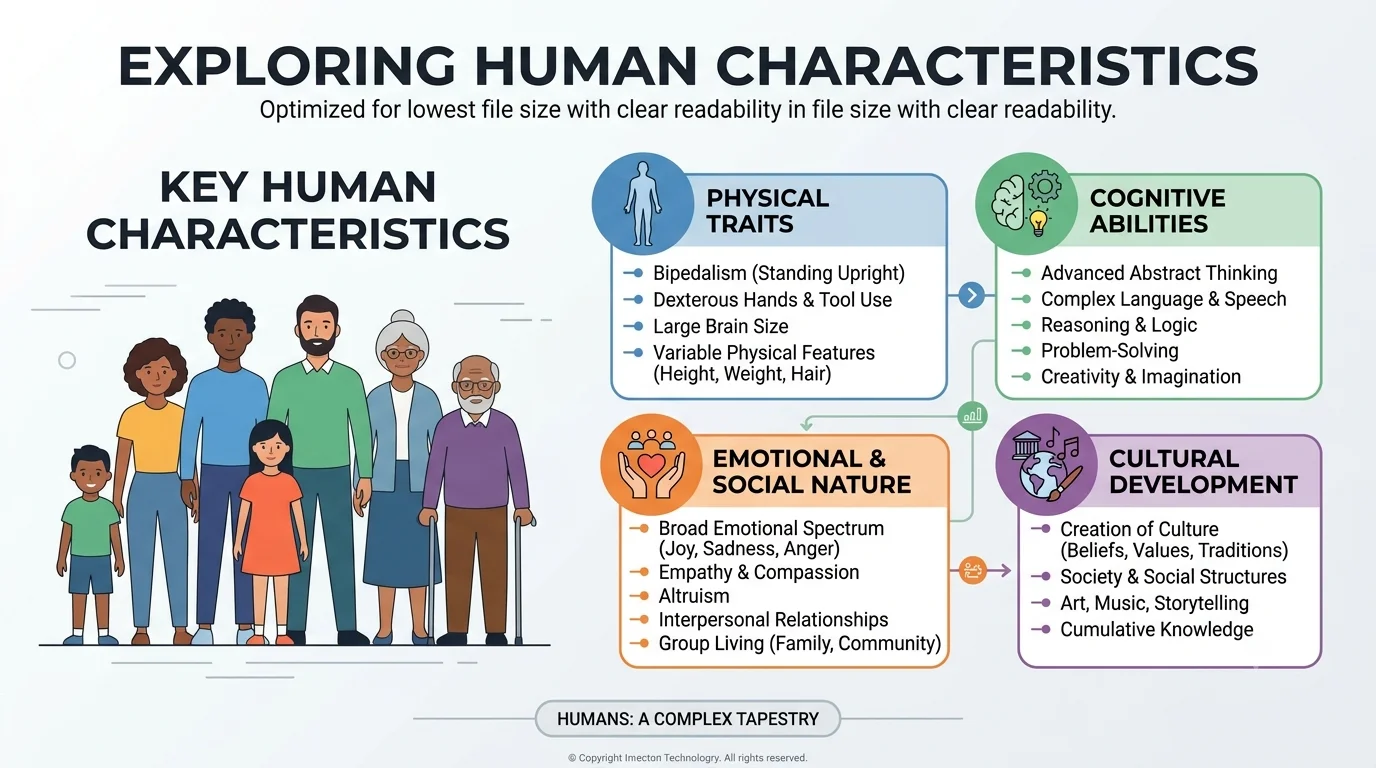
Human Characteristics: What Makes Us Distinctly Human?
Human characteristics span biology, cognition, language, and morality. What separates Homo sapiens from every other species is not a single trait but a cluster of interconnected characteristics:
| Characteristic | Description |
|---|---|
| Language | Complex symbolic communication with grammar and syntax |
| Abstract thinking | Ability to reason about things that don’t physically exist |
| Self-awareness | Consciousness of one’s own existence and actions |
| Tool use and creation | Building and using instruments to change the environment |
| Moral reasoning | Evaluating actions as right or wrong based on principles |
| Cultural transmission | Passing knowledge across generations through teaching |
| Emotional complexity | Experiencing and regulating a wide spectrum of emotions |
| Collaborative intelligence | Working together to solve problems no individual could solve alone |
These human characteristics did not appear overnight. They developed over hundreds of thousands of years of evolutionary pressure, social living, and cumulative cultural learning. Anthropologists at Harvard’s Department of Human Evolutionary Biology describe this cluster as “the suite of characteristics that enabled complex civilization.”
Innate vs. Learned Characteristics
One of the most important distinctions in understanding any characteristic is whether it was born with the individual or developed through experience. This is the classic nature vs. nurture debate — and modern science shows both matter deeply.
Innate characteristics are present from birth or emerge from genetic programming. They require no teaching and appear across all members of a species.
Examples of innate human characteristics:
- The instinct to cry when in pain
- Facial recognition ability (present in newborns)
- Basic emotional expressions like fear, joy, and disgust (found universally across cultures, per Paul Ekman’s cross-cultural research)
Learned characteristics develop through experience, environment, education, and repeated behavior.
Examples of learned characteristics:
- Reading and writing ability
- A second language
- Professional skills like surgical technique or software engineering
- Social behaviors shaped by upbringing and culture
The truth is that most significant human characteristics sit at the intersection. Empathy, for instance, has a strong biological foundation — humans are born with mirror neurons that help them resonate with others’ experiences — but empathy also grows or diminishes depending on how a person is raised and what environments they’re exposed to.
Characteristics vs. Personality Traits: What’s the Difference?
People often use characteristics and personality traits interchangeably, but there is a meaningful distinction:
- Characteristics is the broader term. It covers physical, biological, behavioral, psychological, and social features of any entity — not just people.
- Personality traits specifically refer to stable psychological patterns in human behavior and thought.
Every personality trait is a characteristic, but not every characteristic is a personality trait.
For example, being 6 feet tall is a characteristic of a person, but not a personality trait. Being persistently optimistic is both a characteristic and a personality trait.
The most widely validated model of personality traits is the Big Five (OCEAN):
| Trait | What It Describes |
|---|---|
| Openness | Curiosity, creativity, and willingness to try new ideas |
| Conscientiousness | Organization, dependability, and goal-directed behavior |
| Extraversion | Sociability, assertiveness, and energy in social settings |
| Agreeableness | Warmth, cooperation, and concern for others |
| Neuroticism | Emotional instability, anxiety, and mood variability |
These five personality characteristics are measured across cultures worldwide and have shown remarkable consistency in predicting life outcomes across health, relationships, and career performance (McCrae & Costa, 2008).
Key Characteristics of Effective Leaders
Leadership research has identified a specific set of characteristics that appear consistently among people who build high-performing teams and drive meaningful change.
1. Clarity of communication
Effective leaders state what they mean without ambiguity. They define goals, explain reasoning, and give feedback in language everyone understands.
2. Emotional intelligence
This characteristic — the ability to read, manage, and respond to emotions in oneself and others — is one of the strongest predictors of leadership success. Daniel Goleman’s foundational research at Harvard identified emotional intelligence as more predictive of leadership effectiveness than technical skill or IQ.
3. Decisiveness
Leaders with this characteristic can make sound decisions with incomplete information and stand by those decisions while remaining open to new evidence.
4. Accountability
They do not deflect blame. They own outcomes — good and bad — and create cultures where others feel safe to do the same.
5. Vision
The characteristic of seeing long-term possibility, and translating that into short-term priorities, separates managers from genuine leaders.
6. Adaptability
In rapidly changing environments, the ability to pivot without losing direction is a critical leadership characteristic. The COVID-19 pandemic tested this in organizations worldwide, and those with adaptive leaders weathered disruption far better.
Characteristics in Biology: How Living Things Are Classified
Biology built its entire classification system — taxonomy — around shared and differing characteristics. Carl Linnaeus introduced this system in the 18th century, and modern genomics has only deepened it.
The seven levels of biological classification — Kingdom, Phylum, Class, Order, Family, Genus, and Species — represent progressively narrower sets of shared characteristics.
The defining characteristics of living organisms include:
- Cellular organization — all living things are made of one or more cells
- Metabolism — the ability to take in and process energy
- Growth and development — changing in structure and function over time
- Response to stimuli — reacting to environmental signals
- Reproduction — producing offspring to continue the species
- Homeostasis — maintaining internal stability despite external change
- Heredity — passing characteristics to offspring through genetic material
These seven biological characteristics define life itself. Viruses, notably, meet only some of these criteria — which is why the scientific community still debates whether viruses are truly “alive.”
Positive Characteristics Worth Developing
Beyond description, characteristics are also aspirational. Here are powerful positive characteristics — backed by psychology research — worth actively developing:
Integrity — acting consistently with your stated values, even when no one is watching. Integrity builds trust faster than any other characteristic.
Curiosity — people with high curiosity continuously expand their knowledge base. Research from the University of California, Davis found that curiosity enhances memory formation and deepens learning.
Perseverance — Angela Duckworth’s landmark research on “grit” found that this characteristic — sustained effort toward long-term goals — predicts achievement better than talent alone.
Kindness — beyond its social value, consistent kindness activates positive neurological feedback loops that benefit the giver as much as the recipient.
Self-discipline — the characteristic of delaying immediate gratification for longer-term reward correlates strongly with health, financial security, and relationship stability.
Humility — the characteristic of accurate self-assessment (not self-deprecation) makes people easier to work with, faster to learn, and more effective in teams.
Courage — acting despite fear, especially when it involves standing up for what’s right. This characteristic, more than any other, earns lasting respect.
How Characteristics Are Assessed and Measured
Measuring characteristics is a science in itself. Different fields use different tools:
Psychological assessment tools:
- The Big Five Inventory (BFI) — the most widely used personality characteristics scale
- Myers-Briggs Type Indicator (MBTI) — widely used in organizational settings (though criticized for reliability concerns by many researchers)
- Hogan Personality Inventory — specifically designed for predicting workplace behavior
- Structured clinical interviews — used in mental health assessment
Biological and genetic assessment:
- Genome sequencing — identifies inherited biological characteristics
- Phenotyping — measuring observable biological traits
- Twin studies — compare characteristics in identical vs. fraternal twins to separate genetic from environmental influence
Behavioral assessment:
- Structured behavioral interviews in hiring
- 360-degree feedback tools in leadership development
- Behavioral observation in educational and clinical settings
Educational assessment:
- Standardized testing (academic characteristics)
- Portfolio-based assessment (creative and applied characteristics)
- Project-based learning evaluations
No single method captures the full range of any individual’s characteristics. The most accurate picture comes from combining multiple assessment approaches.
Characteristics That Define High-Performing Organizations
Organizations, like individuals, carry characteristics. The most successful ones share a recognizable set of cultural and operational traits:
| Organizational Characteristic | What It Looks Like |
|---|---|
| Psychological safety | People speak up, challenge ideas, and admit mistakes without fear |
| Clear purpose | Every team member understands why the organization exists |
| Strong feedback culture | Regular, honest, two-way communication across all levels |
| Continuous learning | Investment in upskilling and knowledge-sharing is built in |
| Operational discipline | Processes are followed, goals are tracked, and results are owned |
| Customer obsession | Decisions are consistently made by asking “what’s best for the people we serve?” |
Google’s Project Aristotle — a multi-year internal study on team effectiveness — found that psychological safety was the single strongest predictor of high performance. It was more important than the skills, experience, or characteristics of individual team members.
FAQs About Characteristics
What is the simplest definition of characteristics?
Characteristics are the qualities or features that define and distinguish a person, object, organism, or concept from others. They can be physical, behavioral, psychological, or biological.
Supporting detail: The term applies universally — from the characteristics of a chemical compound to the defining traits of a historical figure. Any feature that consistently describes something and helps identify it counts as a characteristic.
What are the most important human characteristics?
The most important human characteristics include language, abstract reasoning, self-awareness, empathy, moral judgment, and the ability to transmit knowledge across generations.
Supporting detail: These characteristics are not independent. Language enables knowledge transmission. Self-awareness enables moral reasoning. Each characteristic strengthens the others, creating the complex web of abilities that defines human experience.
Can characteristics change over time?
Yes. Many characteristics — especially behavioral and psychological ones — change throughout life. Physical characteristics also shift with age, health, and environment. Even some genetic characteristics only express under specific conditions.
Supporting detail: Neuroplasticity research shows the brain rewires itself in response to experience, meaning psychological and behavioral characteristics remain changeable throughout adulthood. A person can become more empathetic, more disciplined, or more socially skilled through deliberate effort.
What is the difference between a characteristic and a quality?
Characteristics and qualities are closely related but not identical. A quality often implies a judgment (good or bad), while a characteristic is more neutral — it simply describes what something is.
Supporting detail: “Stubbornness” is a characteristic that might be called a negative quality in one context (refusing to accept feedback) but a positive quality in another (refusing to quit on an important goal). The characteristic itself is neutral; its evaluation depends on context.
Are characteristics inherited or developed?
Most meaningful characteristics involve both inheritance and development. Genetics sets a range of possibilities; environment, experience, and choice determine where within that range a person lands.
Supporting detail: Twin studies from the Minnesota Study of Twins Reared Apart found that identical twins raised separately still share many personality characteristics, pointing to strong genetic contributions. Yet environmental factors consistently shift the expression of those characteristics — particularly in social and emotional domains.
How do I identify my own characteristics?
Start with self-observation: notice your consistent behavioral patterns, emotional responses, and decision-making tendencies. Then add external feedback — ask trusted people what they consistently notice about you. Finally, use validated tools like the Big Five assessment for a structured view.
Supporting detail: The most accurate self-knowledge comes from combining introspection with external evidence. What you think you’re like and what you actually do in challenging situations often differ — and that gap is where the most important self-knowledge lives.
Understanding Characteristics Across Cultures
Cultural context profoundly shapes which characteristics are valued, expressed, and even noticed. A characteristic celebrated in one culture may be misread in another.
For example:
- Directness is a highly valued communication characteristic in many Northern European countries, where it signals respect and clarity. In some East Asian and Middle Eastern cultures, indirect communication is the norm, and excessive directness may read as rudeness.
- Individual achievement is a celebrated characteristic in the United States and parts of Western Europe. In many collectivist cultures across Asia, Africa, and Latin America, group harmony and collective success are the more valued characteristics.
- Emotional restraint is valued as a sign of strength and maturity in some cultures. In others, open emotional expression is the expected and respected characteristic.
This cultural dimension of characteristics matters enormously in international business, diplomacy, education, and healthcare. Assuming universal standards for what a “good” characteristic looks like leads to misunderstanding and missed connection.
The Relationship Between Characteristics and Identity
Characteristics are the building blocks of identity — but identity is not simply the sum of its parts.
A person might share individual characteristics with millions of others: the same height, the same sense of humor, the same political values. What makes identity distinct is the particular combination and expression of those characteristics in context.
Psychologists distinguish between:
- Core characteristics — stable, central traits that remain consistent across situations and time
- Surface characteristics — context-dependent traits that appear in some settings but not others
- Aspirational characteristics — traits a person is actively working to develop
Identity formation — the process of figuring out who you are — is largely the process of discovering which characteristics feel genuinely yours, which ones were imposed by others, and which ones you want to intentionally build.
Characteristics in Education: Why Teachers Pay Attention to Student Traits
In education, understanding student characteristics is not a luxury — it’s essential to effective teaching.
Research from Stanford’s Center for Education Policy Analysis shows that teachers who adapt their instruction to the learning characteristics of individual students produce significantly better outcomes than those who teach to an assumed average.
Key student characteristics that affect learning:
- Learning style tendencies (visual, auditory, kinesthetic — though these are fluid, not fixed categories)
- Intrinsic motivation level — the degree to which a student is internally driven
- Prior knowledge — what a student already knows shapes what they can absorb next
- Attention regulation — the ability to maintain focus under distraction
- Growth mindset — Carol Dweck’s research at Stanford showed that students who believe their characteristics can develop through effort consistently outperform those who believe their traits are fixed
Recognizing these characteristics allows teachers to scaffold support, set appropriate challenges, and communicate in ways that actually land.
Quick Reference: Characteristics by Category
| Category | Examples |
|---|---|
| Physical | Height, eye color, bone density, hair texture |
| Behavioral | Punctuality, risk tolerance, communication style |
| Psychological | Resilience, empathy, curiosity, conscientiousness |
| Biological/Genetic | Blood type, lactose tolerance, hereditary conditions |
| Social | Cooperativeness, cultural adaptability, relational trust |
| Cultural | Values, traditions, language, collective norms |
| Organizational | Psychological safety, feedback culture, purpose clarity |
| Leadership | Emotional intelligence, decisiveness, vision, integrity |
The Right Way to Describe Characteristics
Describing characteristics accurately — whether of yourself, others, or a system — requires precision and honesty. Here are principles that improve how you identify and communicate characteristics:
Be specific, not vague. “She is a good communicator” tells you little. “She consistently gives clear feedback that names what worked, what didn’t, and what to change next time” tells you something real.
Distinguish observation from interpretation. “He interrupted me three times during the meeting” is an observation. “He is disrespectful” is an interpretation. Both may be true, but they carry different weight and demand different responses.
Acknowledge context-dependence. Most characteristics are not fixed absolutes. A person who seems passive in one setting may be highly assertive in another. A quality that looks like a weakness in one role may be a strength in another.
Use evidence. When assessing characteristics — especially in professional settings — ground your assessment in specific, observable examples. This approach increases accuracy and reduces bias.
Build on What You Now Know
Characteristics are everywhere — in the genetic code that built you, the cultural air you breathed growing up, the behavioral patterns you’ve reinforced through years of choices, and the psychological traits that shape every decision you make.
Understanding characteristics is not a passive exercise. It opens practical doors:
- For self-development: identify which of your characteristics serve you well and which ones hold you back — then work with that honestly
- For relationships: understanding another person’s core characteristics builds empathy and reduces conflict
- For leadership: building teams with complementary characteristics outperforms stacking teams with identical strengths
- For learning: knowing your own cognitive and motivational characteristics lets you design study and work environments that actually fit you
The most powerful thing you can do with this knowledge is apply it. Take a validated personality assessment. Ask three people you trust what they consistently notice about you. Look at a pattern in your behavior that you’ve never named — and name it.
Characteristics only become tools when you understand them well enough to use them.