What Is the Alternative Learning System? Meaning & Benefits
Alternative Learning System Meaning: Your Path to an Accredited Diploma
You left school early. Now job applications ask for a diploma you don’t have, and that gap blocks your confidence every day. You deserve a second shot that fits your schedule, not another dead end. The Alternative Learning System hands you exactly that—a free, government-backed program that turns your life experience into a recognized high school diploma. This guide shows you the complete roadmap.
What Does Alternative Learning System Mean?
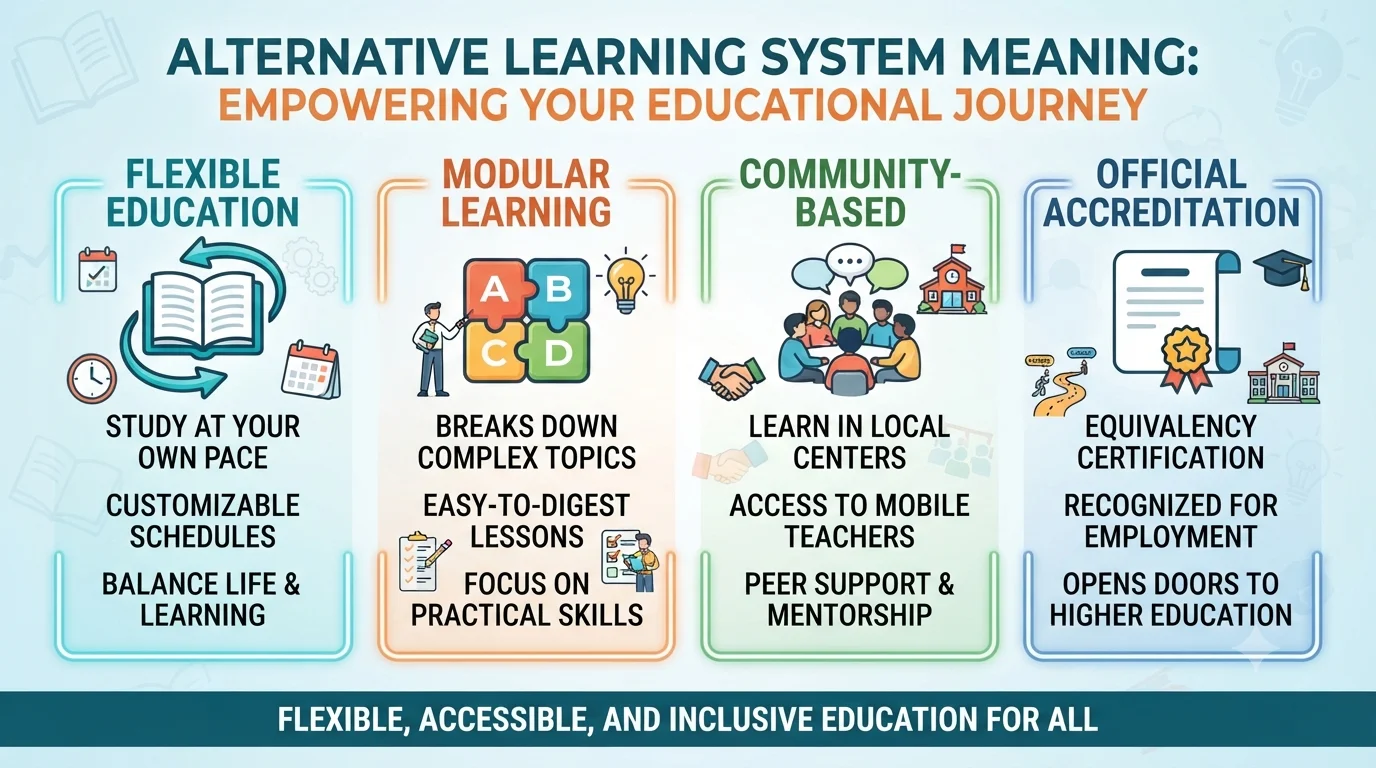
The alternative learning system meaning starts with a simple promise: education must reach everyone, even those who dropped out of formal classrooms. ALS is a parallel learning pathway run by the Philippine Department of Education (DepEd) under Republic Act 11510. It replaces rigid school years with self-paced modules, mobile teachers, and an equivalency test that awards a diploma identical to a traditional high school certificate. You study at home, in a community center, or through digital lessons—no uniform, no fixed bell schedule, and no tuition fee. The DepEd ALS Task Force defines this alternative learning system meaning as a “lifeline for marginalized learners,” ensuring that age, poverty, and geography do not permanently close the door to education.
Who Created the Alternative Learning System and Why?
The Bureau of Alternative Education (BAE), a DepEd arm, designed ALS to tackle a staggering dropout crisis. According to the Philippine Statistics Authority’s 2020 Census, over 3.8 million Filipinos aged 6 to 24 remained out of school. Many left because of family emergencies, child labor, armed conflict, or sheer distance from the nearest classroom. The government passed the ALS Act in 2020 to give every out-of-school youth and adult a constitutional right to quality education. The law anchors the alternative learning system meaning in legal mandate, not charity. DepEd Order No. 13, s. 2019 further structured the program, creating Instructional Managers and mobile teachers who bring learning materials straight to barangay halls, remote sitios, and even jail facilities.
How the Alternative Learning System Works: Modules, Sessions, and Assessments
When you enroll, you receive printed or digital learning modules covering the same competencies as the K-12 curriculum, condensed into bite-sized lessons. A mobile teacher or Instructional Manager guides you through each module in a group session or one-on-one visit. You write answers, solve problems, and practice life skills at your own speed. Once you feel ready, you take the Accreditation and Equivalency (A&E) Test, a national exam that measures your mastery. Pass it, and DepEd issues a diploma or certificate that proves the true alternative learning system meaning: your knowledge holds equal weight to formal schooling.
The learning delivery comes in two streams:
- Basic Literacy Program (BLP): For those who cannot read, write, or compute. It builds foundational skills before transitioning to the elementary level.
- Continuing Education Program (Accreditation & Equivalency): For elementary and secondary level learners aiming to earn a diploma equivalent.
A 2023 UNESCO Institute for Lifelong Learning report on non-formal education in Southeast Asia singled out the Philippine ALS as a model for its blend of modular print materials and community-based facilitation.
ALS vs Traditional Schooling: A Detailed Comparison Table
Understanding the alternative learning system meaning becomes crystal clear when you place it side by side with the formal K-12 system.
| Aspect | Alternative Learning System (ALS) | Traditional K-12 School |
|---|---|---|
| Structure | Self-paced, modular, flexible schedule | Fixed daily schedule, grade levels, academic calendar |
| Learning Venue | Barangay hall, home, community center, online | Classroom inside a school campus |
| Teacher Role | Mobile teacher, Instructional Manager, facilitator | Subject teacher delivering fixed lessons |
| Age Limit | No maximum age; open to 15 years and above | Typically 5–18 years old per grade cohort |
| Cost | Free, including modules and A&E test fees | Free in public schools, but often includes miscellaneous costs |
| Credential | Elementary/Secondary diploma via A&E Test | High school diploma via K-12 completion |
| Curriculum Basis | ALS K-12 Basic Education Curriculum aligned with formal competencies | K-12 Enhanced Basic Education Curriculum |
| Pace | Learner-driven; finish in months or years | Fixed 10–12 years |
| Support System | Flexible groupings, peer learning, community linkages | Homeroom, guidance counselor, subject clubs |
This table shows the alternative learning system meaning in action: it erases the barriers that keep working adults, young parents, and indigenous learners from earning a recognized credential.
Who Qualifies to Enroll in the Alternative Learning System?
Any Filipino citizen aged 15 and above who missed basic education can register. The program especially welcomes out-of-school youth, adult illiterates, persons deprived of liberty, indigenous peoples, and workers craving promotion. There is no maximum age limit, no entrance exam, and no prior transcript requirement. This open-door policy defines the alternative learning system meaning as an unconditional second chance. DepEd’s Enrollment Guidelines, updated March 2023, require only a filled-out registration form, a birth certificate or affidavit, and a short placement test to determine your starting literacy level.
The ALS Curriculum: What Subjects Will You Learn?
The curriculum mirrors the formal K-12 competencies but strips away the fluff. Five learning strands shape every module:
- Communication Skills (English and Filipino): Reading, writing, speaking, and listening for daily life and work.
- Scientific and Critical Thinking Skills: Practical science, math, and problem-solving applied to real situations.
- Mathematical and Problem-Solving Skills: Basic arithmetic, financial literacy, measurement, and data interpretation.
- Life and Career Skills: Livelihood training, entrepreneurship, workplace ethics, and digital literacy.
- Understanding Self and Society: Civics, Philippine history, health, and environmental awareness.
Each strand strengthens the alternative learning system meaning—education that connects directly to your survival, dignity, and personal growth, not just exam scores.
Accreditation and Equivalency Test: How to Earn Your Diploma
The A&E Test transforms learning into a legal credential. DepEd administers it twice a year across thousands of testing centers. The exam covers all five learning strands through multiple-choice questions and an essay. Passers receive either an Elementary Certificate or a Secondary Diploma. The Philippine Statistics Authority and the Civil Service Commission recognize this diploma for employment, voter registration, and college admission. This official parity is the living proof of the alternative learning system meaning: your self-taught knowledge stands equal to a classroom graduate’s. According to DepEd’s 2022 A&E results, the passing rate climbed to 72.3%—a number that reflects better learning materials and motivated learners.
Where to Find ALS Centers and How to Register
Every city and municipality has a Community ALS Learning Center, often housed in a barangay hall or public school. Mobile teachers also travel to far-flung sitios. To register, visit the nearest DepEd Schools Division Office or approach a barangay official who coordinates ALS schedules. Bring any valid ID and a pen. Registration is ongoing throughout the year, not tied to a June school opening. Walk in, express interest, and sit for the Functional Literacy Test. This walk-in accessibility captures the alternative learning system meaning at ground level—no red tape, just immediate opportunity.
Real-Life Success Stories from ALS Graduates
The alternative learning system meaning shines brightest in human achievement. Rose Ann, a 34-year-old mother from Quezon City, left school at 14 to work as a kasambahay. She passed the A&E Test in 2021, earned a scholarship to a technical-vocational school, and now runs a small baking business. Jun, a former construction worker from Cebu, used his ALS diploma to join the Philippine Army—a career path that once felt permanently locked. The Philippine News Agency documented the story of Araw ng Kagitingan awardee Mang Andoy, an Aeta elder who completed elementary ALS at age 62, proving that learning has no expiration date. These narratives prove the alternative learning system meaning moves beyond policy papers into real, changed lives.
Benefits of Completing the Alternative Learning System
Finishing ALS creates a cascade of practical gains.
- Opens the door to college, TESDA technical courses, and government job applications.
- Raises your salary grade eligibility in the Philippine Civil Service.
- Boosts self-esteem and breaks cycles of intergenerational poverty.
- Gives you full legal documentation for overseas work applications.
- Connects you to a national community of ALS alumni and support networks.
Every diploma confirms the alternative learning system meaning: you are not a dropout, you are a graduate.
Common Challenges and How to Overcome Them
ALS learners face hurdles, yet each has a fix. Many struggle with module overload. Break one module into small daily tasks and join a peer study circle. Others lose momentum due to work demands. Coordinate with your mobile teacher to adjust session timing around your shift. Limited internet access can block the digital portal. Request printed modules from your Community Learning Center; DepEd’s ALS 2.0 initiative guarantees hard copies for offline areas. Fear of the A&E Test looms large. Attend the free review sessions held by mobile teachers, and practice with the official DepEd Reviewer available online. Understanding the alternative learning system meaning as a flexible journey, not a rigid race, keeps you moving forward.
Frequently Asked Questions
What is the alternative learning system meaning in simple terms?
The alternative learning system meaning, in plain language, is a free government program that lets out-of-school youth and adults finish basic education through self-paced modules, then take an equivalency test to receive an official diploma.
Who can enroll in the Alternative Learning System?
Any Filipino 15 years or older who has not completed elementary or high school can enroll, regardless of employment status, marital status, or economic background. There is no maximum age limit.
Is the ALS diploma valid for college and work?
Yes. DepEd and the Commission on Higher Education recognize the ALS diploma as equivalent to a traditional high school diploma. You can use it to apply for college, TESDA courses, government jobs, and overseas employment.
How much does the Alternative Learning System cost?
Everything is free. Registration, learning modules, teacher guidance, and the A&E Test carry zero fees. The government funds ALS entirely through the DepEd budget and local partnerships.
How long does it take to complete ALS?
Completion time depends on your pace and prior knowledge. Some learners finish the secondary level in 8–10 months of consistent study; others take up to two years. The program bends to your life, not the other way around.
Where can I find ALS modules online?
DepEd’s ALS 2.0 portal at als.deped.gov.ph provides downloadable digital modules for all learning strands. You can also access audio lessons and video reviewers through the DepEd Commons and partner YouTube channels.
Start Your Diploma Journey Now
You just absorbed the complete alternative learning system meaning—a real, zero-cost bridge from dropout to diploma holder. Walk to the nearest DepEd office or barangay hall this week and ask for the ALS mobile teacher. Fill out one form. Accept the first module. The program waits for no perfect season; it waits for your decision. Share this article with a neighbor, a relative, or a coworker who still believes their education ended years ago. Subscribe to our newsletter below and receive step-by-step enrollment guides, free reviewer materials, and success stories that push you toward your own graduation day.