What Is Submissive Meaning? Definition, Traits and Signs
Submissive Meaning: Complete Definition, Traits and Signs
Ever caught yourself agreeing with someone just to avoid an argument, even when you disagreed? That small moment says more about personality than most people realize. Understanding submissive meaning helps explain why some people yield easily while others push back, and why that pattern shows up at work, at home, and in friendships alike. This guide breaks it all down clearly.
The word “submissive” describes a person, animal, or behavior that yields to the authority, control, or wishes of someone else. It shows up in psychology, workplace dynamics, family relationships, and even animal behavior research. This page covers the full submissive meaning across every relevant context, backed by psychological research and clear, real-world examples.
Submissive Meaning: The Core Definition
At its simplest, submissive meaning refers to a willingness to yield, comply, or defer to another person’s authority or decisions. The word functions as an adjective, describing a trait, behavior, or role rather than a fixed identity.
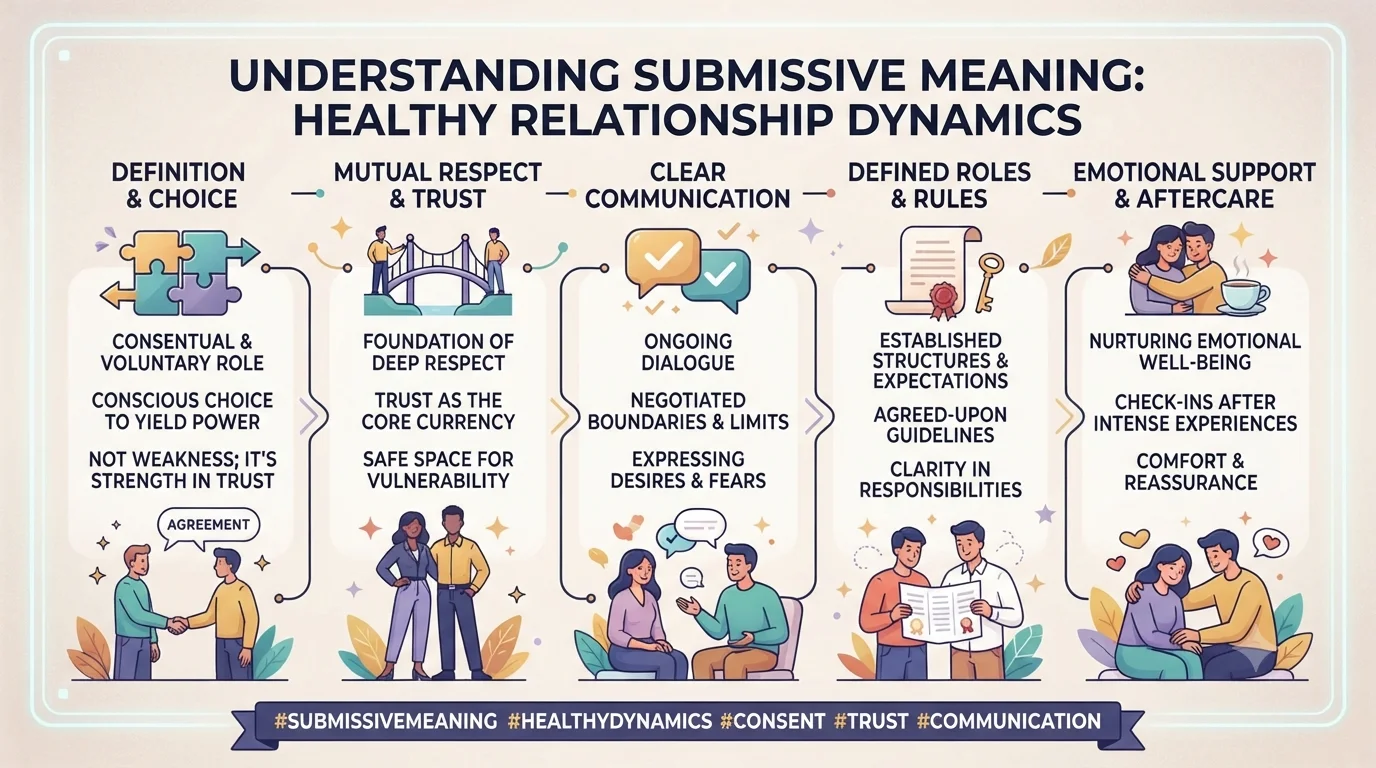
A submissive person often prioritizes harmony over conflict. They tend to agree quickly, avoid confrontation, and let others take the lead in decision-making. This doesn’t automatically signal weakness. In many cases, submissiveness reflects a conscious choice to cooperate rather than an inability to assert oneself.
Dictionaries generally define submissive as “ready to conform to the authority or will of others; meekly obedient or passive.” That definition captures the surface behavior, but the psychology behind it runs much deeper.
Where the Word “Submissive” Comes From
The word traces back to the Medieval Latin term “submissivus,” built from “sub-” (meaning “under”) and “mittere” (meaning “to send”). Combined, the root essentially means “to send under” or “to lower oneself.”
This etymology matches the modern meaning closely. Someone acting submissively is, in a literal sense, placing themselves under another person’s direction rather than asserting their own position.
Submissive vs Passive vs Assertive: Key Differences
People often confuse submissiveness with passivity, but the two aren’t identical. This table breaks down the differences clearly.
| Trait | Definition | Typical Behavior | Underlying Motivation |
|---|---|---|---|
| Submissive | Willingly yields to another’s authority | Agrees, defers, follows instructions | Values harmony, trust, or avoiding conflict |
| Passive | Avoids expressing opinions or needs | Stays silent, withdraws from decisions | Fear of judgment or low self-worth |
| Assertive | Expresses needs while respecting others | States opinions clearly, sets boundaries | Confidence and mutual respect |
| Aggressive | Dominates or controls others | Demands, interrupts, dismisses others’ views | Need for control or dominance |
Understanding this distinction matters because a submissive person can still be confident and self-aware. Passivity, on the other hand, usually stems from fear rather than choice.
Psychological Traits Commonly Linked to Submissiveness
Psychologists have studied submissiveness as a personality trait for decades, most notably through the work of researchers like Millon and Davis. Several traits repeatedly show up in submissive individuals.
- Conflict avoidance: A strong preference for peace over confrontation, even at personal cost.
- High empathy: A tendency to notice and prioritize other people’s needs and emotions.
- Low assertiveness: Difficulty stating personal opinions or pushing back on requests.
- People-pleasing tendencies: A drive to gain approval and avoid disappointing others.
- Self-awareness: Many submissive individuals understand their own boundaries clearly, even if they rarely voice them.
- Dependency on external validation: A need for reassurance from authority figures or partners.
Not every submissive person shows all these traits, and the intensity varies widely from person to person and situation to situation.
What Causes a Submissive Personality?
Submissiveness rarely appears out of nowhere. Most psychologists trace it back to a mix of upbringing, environment, and personal experience.
- Authoritarian parenting: Growing up in a home where obedience was rewarded and independent thinking was discouraged.
- Childhood trauma or bullying: Learning submission as a coping mechanism to avoid punishment or conflict.
- Cultural or societal norms: Some cultures reward conformity and discourage open disagreement, especially toward elders or authority figures.
- Low self-esteem: Doubting one’s own judgment can make deferring to others feel safer than deciding independently.
- Personal choice: Some individuals simply prefer supportive, cooperative roles and find genuine satisfaction in them.
The last point matters. Not all submissiveness stems from hardship. Some people find real fulfillment in cooperative, service-oriented roles, particularly when the relationship involves mutual trust and respect.
Submissive Behavior in Different Contexts
The submissive meaning shifts slightly depending on where it shows up. Here’s how it plays out across common settings.
At work: A submissive employee may avoid disagreeing with a manager, even when they have a better idea. This can protect harmony short-term but may limit career growth over time.
In families: A submissive child or spouse may consistently defer to a parent or partner’s decisions, sometimes out of respect and sometimes out of fear of conflict.
In friendships: A submissive friend might always let others choose the restaurant, movie, or plan, prioritizing group harmony over personal preference.
In relationships: Some couples establish roles where one partner takes a more submissive position in decision-making. When this arrangement is consensual and mutually respectful, it can strengthen trust rather than create imbalance.
In animal behavior: Researchers studying pack animals like wolves and dogs use “submissive” to describe body language such as lowered heads, avoided eye contact, or rolling over, all signals used to reduce conflict within a group.
Signs Someone Has a Submissive Personality
Recognizing submissive traits in yourself or someone else becomes easier once you know what to look for.
- Frequently says “yes” even when they’d prefer to say “no”
- Avoids sharing personal opinions in group settings
- Apologizes often, even for things outside their control
- Struggles to make decisions without checking with others first
- Feels uncomfortable receiving compliments or praise
- Rarely initiates conflict, even when something bothers them
- Prioritizes others’ comfort over their own needs
If several of these patterns feel familiar, it may point to a submissive tendency worth exploring further, especially if it causes personal frustration or stress.
Is Being Submissive a Bad Thing?
Submissiveness isn’t inherently negative. Context determines whether the trait helps or hurts a person’s wellbeing.
Potential strengths:
- Strong cooperation and teamwork skills
- High empathy and emotional awareness
- Fewer unnecessary conflicts in relationships
- Reliability and follow-through on commitments
Potential challenges:
- Difficulty setting personal boundaries
- Risk of being taken advantage of in unhealthy relationships
- Suppressed needs leading to resentment or burnout
- Lower visibility for ideas or achievements in group settings
The healthiest version of submissiveness involves choice and consent. Problems tend to arise when submission comes from fear rather than genuine preference, or when it leaves a person feeling unseen or unheard.
Submissive Meaning vs Dependent Personality Disorder
It’s worth clarifying that submissiveness is a personality trait, not a mental health disorder. However, extreme, rigid submissiveness can sometimes overlap with Dependent Personality Disorder (DPD), a condition marked by an excessive need to be taken care of and difficulty making everyday decisions without reassurance.
The key difference lies in flexibility and choice. A submissive personality trait allows a person to adapt their behavior depending on the situation. DPD, by contrast, involves a persistent, difficult-to-control pattern that interferes with daily functioning. Anyone concerned about this distinction should speak with a licensed mental health professional for proper evaluation.
How to Become Less Submissive (If You Want To)
Some people are perfectly happy with a cooperative, submissive style. Others want more balance. If you fall into the second group, these steps can help.
- Start small. Practice saying “no” in low-stakes situations before tackling bigger conflicts.
- Identify your non-negotiables. Write down the boundaries that matter most to you.
- Pause before agreeing. Give yourself a moment to check whether you actually want to say yes.
- Practice assertive language. Phrases like “I’d prefer” or “That doesn’t work for me” build confidence over time.
- Seek support if needed. Therapy or coaching can help address deeper causes like low self-esteem or past trauma.
Change doesn’t require becoming someone else. It simply means making sure your choices reflect your own needs, not just everyone else’s.
Frequently Asked Questions
1. What is the simplest submissive meaning? Submissive means willingly yielding to another person’s authority, decisions, or control, often to keep peace or show respect rather than out of weakness.
2. Is submissive the same as being weak? No. Submissiveness reflects a behavioral choice or personality trait, not a lack of strength. Many submissive individuals are highly self-aware and confident in their decision to cooperate.
3. Can a person be submissive in some situations but not others? Yes. Many people act submissively at work but assertively at home, or vice versa. Submissiveness often depends on context, relationship dynamics, and comfort level rather than being a fixed trait.
4. What causes someone to become submissive? Common causes include authoritarian upbringing, low self-esteem, cultural norms around obedience, or past experiences with conflict. Some people also choose submissiveness simply because it suits their personality.
5. Is submissiveness a mental health condition? No, submissiveness itself is a personality trait, not a disorder. However, extreme and rigid submissiveness can sometimes overlap with conditions like Dependent Personality Disorder, which requires professional evaluation.
6. How is submissive different from passive? Submissive behavior often involves a conscious choice to defer to someone else, while passive behavior typically stems from fear or an inability to express personal needs and opinions at all.
Final Thoughts
Submissive meaning covers far more than a single dictionary line. It touches personality psychology, relationship dynamics, workplace behavior, and even animal communication. Whether you recognize these traits in yourself or someone close to you, understanding the “why” behind submissiveness makes it easier to build healthier, more balanced relationships. If this breakdown helped clarify things, explore our related guides on assertiveness training and healthy boundary-setting to keep building your understanding.
Sources: Peer-reviewed psychology research on personality traits (Millon and Davis, 1998), ScienceDirect’s overview of submissive behavior, and established English-language dictionaries were referenced to verify definitions, origins, and psychological concepts cited in this guide.