Food Lion: History, Stores, Net Worth, Products & 2026 Guide
Food Lion at a Glance
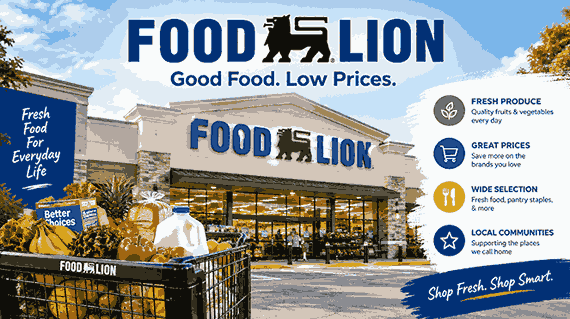
Walk through a modern grocery store in the American Southeast and you may notice the familiar lion logo before you reach the produce section. For millions of shoppers, Food Lion represents everyday groceries, weekly deals, convenient locations, and a long connection with local communities.
The company has an unusually long story for a modern supermarket chain. It began in Salisbury, North Carolina, in 1957 under another name and eventually developed into one of the major supermarket brands operated by Ahold Delhaize USA.
Today, the retailer operates more than 1,100 stores across 10 Southeastern and Mid-Atlantic states. Its business now combines physical supermarkets, online shopping, digital savings, pharmacy services in applicable locations, private-label products, and community programs.
Food Lion Quick Profile
| Category | Details |
| Company | Food Lion, LLC |
| Founded | 1957 |
| Original name | Food Town |
| Headquarters | Salisbury, North Carolina |
| Parent company | Ahold Delhaize USA |
| Current footprint | 1,100+ stores |
| States served | 10 |
| Associates | 82,000+ |
| Business type | Grocery and omnichannel retail |
| Core promise | Easy, Fresh & Affordable |
| Major community program | Food Lion Feeds |
| 2025 reported stores | 1,110 |
| Online pickup points in 2025 | 793 |
The 2025 Ahold Delhaize annual report listed 1,110 Food Lion stores and 793 pickup points at the end of the year.
Food Lion Social Media and Quick Info
Because social follower totals change constantly, current follower numbers should be checked directly on the retailer’s verified profiles rather than treated as permanent figures.
| Platform / Metric | Food Lion Information |
| Official Food Lion social presence; follower count changes | |
| Official Food Lion page | |
| X | Official Food Lion social presence |
| TikTok | Food Lion-related content and promotions are active on the platform |
| Career peak | 1,100+ stores and 82,000+ associates |
| Financial scale | Part of Ahold Delhaize, which reported €92.4 billion in 2025 group net sales |
| Key popularity driver | Grocery value, weekly promotions, convenience and community presence |
Ahold Delhaize reported €92.4 billion in group net sales for 2025, but that figure covers the entire company rather than Food Lion alone. Food Lion’s own standalone net worth is not publicly disclosed.
What Is Food Lion?
Food Lion is an American supermarket chain headquartered in Salisbury, North Carolina.
It operates as an omnichannel grocery retailer, meaning customers can shop through traditional stores as well as digital channels. The company’s current footprint covers Delaware, Georgia, Kentucky, Maryland, North Carolina, Pennsylvania, South Carolina, Tennessee, Virginia, and West Virginia.
The business focuses heavily on affordable groceries, fresh food, convenient shopping, private-label merchandise, promotions, and digital savings.
That positioning has remained central to the brand for decades.
The company’s current slogan centers on being “Easy, Fresh & Affordable,” reflecting the three ideas it uses to describe its customer proposition.
The Food Lion Life Story: From Food Town to Major Grocer
1957: The Beginning
The story started in 1957 in Salisbury, North Carolina.
The original business was called Food Town. Salisbury remained important to the company’s identity as the chain expanded over subsequent decades.
Starting as a regional grocery operation gave the company a foundation built around local shoppers rather than a national supermarket model.
That regional identity would remain important even as the business became much larger.
Expansion Across the Southeast
The company gradually expanded beyond its original market.
More stores brought the brand into communities throughout the Southeast and Mid-Atlantic regions. As the network grew, the business became increasingly recognizable for its combination of supermarket convenience and value-focused pricing.
Its expansion eventually created a large store base spanning 10 states.
The Food Lion Name
The Food Town name did not remain forever.
The business eventually adopted the Food Lion identity, helping establish the lion logo as one of its most recognizable visual symbols.
The company continued to maintain its Salisbury roots while developing a much broader retail footprint.
Ahold Delhaize Ownership
Food Lion is now part of Ahold Delhaize USA.
Ahold Delhaize is an international food retail group with multiple well-known supermarket brands. Its 2025 annual report identifies Food Lion as a 1957-established brand operating supermarkets and online shopping services.
This relationship gives Food Lion access to the scale of a much larger retail organization while allowing the brand to retain its regional identity.
Food Lion Net Worth and Financial Picture
One important point needs clarification.
Food Lion does not publish a standalone “net worth” figure in the way a celebrity or publicly traded company might.
It is a subsidiary brand within Ahold Delhaize USA. Therefore, assigning a precise net-worth figure to Food Lion would create a number that cannot be reliably verified from public financial reporting.
The better way to understand its financial scale is through its parent company’s published results and Food Lion’s operating footprint.
Ahold Delhaize reported €92.4 billion in total net sales in 2025. Its U.S. businesses generated €53.1 billion in net sales that year.
The company also reported €10.3 billion in online sales worldwide during 2025.
These numbers show the scale of the corporate group behind Food Lion, but they should not be described as Food Lion’s individual revenue.
Why a Food Lion Net Worth Estimate Can Be Misleading
A supermarket brand has assets that are difficult to value from public information.
Those assets can include stores, distribution infrastructure, inventory, intellectual property, customer relationships, technology, private-label brands, and other operational resources.
Food Lion’s parent company reports consolidated financial results rather than publishing a simple valuation for each brand.
For that reason, the most accurate answer is:
Food Lion’s standalone net worth is not publicly disclosed.
Food Lion in 2025 and 2026
The company entered 2026 from a strong position within Ahold Delhaize’s U.S. business.
In its February 2026 results, Ahold Delhaize said Food Lion had achieved 53 consecutive quarters of comparable sales growth. The company also reported strong online growth across its U.S. brands, with Food Lion leading the fourth-quarter online performance.
Then, in the second quarter of 2026, Ahold Delhaize reported that Food Lion again led brand performance, with sales growth online exceeding 20%.
That makes digital grocery shopping one of the most important parts of the company’s current story.
The retailer is no longer simply a chain of neighborhood supermarkets. Its customer experience increasingly combines stores, online ordering, pickup, digital savings, and other technology-driven services.
Major Food Lion Store Investments
Physical stores remain just as important.
In November 2025, Food Lion announced a $484 million investment covering 153 stores in the greater Charlotte market. The project focused on remodeling stores, improving product assortment, and expanding convenient ready-to-eat options.
The investment also demonstrated how the company is adapting traditional supermarkets to changing shopping habits.
Modern shoppers often want three things at once: affordable prices, fresh products, and speed.
Store renovations can address all three.
What Can You Buy at Food Lion?
A typical Food Lion shop can cover most everyday grocery needs.
Common categories include:
- Fresh fruits and vegetables
- Meat and seafood
- Dairy products
- Eggs
- Bakery items
- Frozen foods
- Pantry staples
- Snacks
- Beverages
- Household products
- Personal-care products
- Baby products
- Pet supplies
- Private-label grocery products
- Prepared and ready-to-eat foods
The exact assortment varies by location.
Larger stores can carry broader selections than smaller locations, while local demand also influences which products receive shelf space.
How to Save Money at Food Lion
Shopping strategically can make a meaningful difference to a weekly grocery budget.
Step 1: Check Weekly Promotions
Start by checking the current weekly deals before visiting the store.
This lets you build meals around products already receiving promotional pricing.
Step 2: Build Your Grocery List
Write down the items you genuinely need.
Separate the list into categories such as produce, meat, dairy, pantry, frozen food, and household supplies.
This makes the trip faster and can reduce impulse purchases.
Step 3: Use Digital Savings
Food Lion has invested heavily in digital shopping and loyalty technology.
Digital tools can help shoppers identify available offers before checkout.
Step 4: Compare Store Brands
Private-label products can sometimes provide a lower-cost alternative to national brands.
Compare package sizes, ingredients, nutrition information, and unit prices rather than looking only at the shelf price.
Step 5: Plan Around Multiple Meals
Buying ingredients that work across several meals can reduce waste.
For example, vegetables purchased for dinner can also become ingredients for lunch the following day.
Food Lion Shopping Comparison
| Shopping Element | Traditional Approach | Value-Focused Approach |
| Grocery list | Shop from memory | Prepare list before leaving |
| Weekly deals | Check after shopping | Check before shopping |
| Store brands | Ignore them | Compare with national brands |
| Produce | Buy without planning | Choose produce for several meals |
| Meat | Buy based on impulse | Plan meals around promotions |
| Digital savings | Use occasionally | Check before every major trip |
| Prepared food | Buy frequently | Use selectively for convenience |
| Food waste | Deal with leftovers later | Plan portions before purchasing |
This approach does not guarantee a specific final bill because prices vary by product, location, and promotion.
Food Lion’s Private-Label Strategy
Private-label products have become an important part of supermarket competition.
For shoppers, they provide another choice between premium national brands and the cheapest available option.
Food Lion has used its own-brand assortment as part of its value proposition. Its broader strategy emphasizes affordability while maintaining a focus on fresh food.
The appeal is straightforward.
A shopper can compare the national brand, store brand, package size, ingredients, and price before making a decision.
Food Lion and Online Grocery Shopping
The grocery industry has changed dramatically as online ordering became normal for many households.
Food Lion has responded by expanding its digital infrastructure.
The 2025 Ahold Delhaize annual report recorded 793 Food Lion pickup points, up from the previous year.
The parent company also reported double-digit online growth across its U.S. operations.
In the second quarter of 2026, U.S. online sales increased 14.5% at constant exchange rates, with Food Lion recording more than 20% growth.
That performance illustrates how online grocery shopping has become part of the company’s mainstream business rather than a side service.
Food Lion Feeds and Hunger Relief
Food Lion’s community work is another major part of its modern identity.
The company’s Food Lion Feeds program was launched in 2014.
According to Food Lion, the program had donated more than 1.5 billion meals to people facing food insecurity by 2025. The retailer has committed to reaching 3 billion meals by 2032.
The company also has a long-running food-rescue program.
Food Lion says its stores donate edible food that cannot be sold to local feeding organizations. The company describes itself as an early grocery-industry pioneer in organized food rescue.
This work connects supermarket operations with local hunger-relief organizations.
Why Food Lion Remains Important to Its Region
The chain’s importance is partly about scale.
With more than 1,100 stores and over 82,000 associates, it has a significant physical presence throughout its operating states.
But scale alone does not explain its identity.
The company has retained its Salisbury, North Carolina, roots while developing a broad regional network.
That combination of local identity and corporate scale is common among successful supermarket brands.
Industry Reaction and Customer Trends
The grocery industry is currently dealing with several competing pressures.
Consumers want affordable prices, but they also expect better convenience and fresh choices.
Retailers are therefore investing in online ordering, loyalty programs, private labels, store remodeling, prepared food, and supply-chain efficiency.
Food Lion’s recent investments fit that wider industry pattern.
Its 2025 Charlotte investment emphasized remodeled stores, product assortment, and ready-to-eat options. Its 2026 performance also highlighted online grocery growth.
For shoppers, the practical result is a grocery model that increasingly blends physical and digital shopping.
Food Lion’s Biggest Strengths
Several characteristics define the brand today.
Regional Reach
The retailer has built a substantial presence across 10 states.
Store Network
More than 1,100 stores give customers many physical shopping options.
Value Positioning
Affordable grocery shopping remains central to the brand’s identity.
Digital Convenience
Online ordering and pickup are now important parts of the customer experience.
Community Programs
Food Lion Feeds gives the company a visible role in hunger-relief efforts.
Store Investment
Recent capital spending shows that physical supermarkets remain a major part of the strategy.
What Makes Food Lion Different From Other Grocery Chains?
There is no single feature that separates every Food Lion store from every competitor.
Instead, the brand combines several elements.
Its strongest identity comes from its regional footprint, value-focused positioning, store network, digital services, and long history in the Southeast and Mid-Atlantic.
The company also benefits from being part of Ahold Delhaize, which provides corporate scale while the Food Lion brand continues operating under its own identity.
Food Lion Timeline
| Year | Major Development |
| 1957 | Business founded as Food Town in Salisbury, North Carolina |
| Later decades | Regional expansion across the Southeast |
| Food Lion era | Brand develops the recognizable lion identity |
| 2011–2014 | Major store and brand-strategy investments accelerate |
| 2014 | Food Lion Feeds reaches a major new phase |
| 2020s | Digital grocery and omnichannel services expand |
| 2025 | 1,110 stores listed in Ahold Delhaize annual report |
| 2025 | $484 million Charlotte-area store investment announced |
| 2026 | Online sales growth remains a major performance driver |
The historical record shows a clear transformation from a local grocery business into a large regional omnichannel retailer.
Frequently Asked Questions
Is Food Lion owned by Ahold Delhaize?
Yes. Food Lion is part of Ahold Delhaize USA, the U.S. division of international food retailer Ahold Delhaize.
What was Food Lion originally called?
Food Lion was founded in Salisbury, North Carolina, in 1957 as Food Town. The business later developed under the Food Lion name.
How many Food Lion stores are there?
Ahold Delhaize reported 1,110 Food Lion stores at the end of 2025, while the retailer currently describes its footprint as more than 1,100 stores.
What is Food Lion’s net worth?
A standalone Food Lion net-worth figure is not publicly disclosed. Because the brand operates within Ahold Delhaize USA, its parent company’s consolidated financial statements provide the more reliable measure of corporate scale